A GPA number looks simple on paper, but the question behind it rarely has a simple answer, because the same number can mean very different things depending on the school, the courses taken, and the goal a student is working toward.
Two students can have the same GPA on their transcripts, yet one may be in a much stronger position for college admissions or career opportunities, simply because of the context behind that number.
The confusion usually comes up when GPA is treated like a fixed benchmark, where anything above a certain number is labeled good, and anything below is seen as weak, without understanding how that number was actually built. A GPA only starts making sense when it is read along with course difficulty, grading system, and the direction in which the student’s performance is moving.

First Thing to Understand About “Good GPA”
A good GPA is not a universal number that applies to every student in the same way, because academic expectations change depending on the type of college, the competitiveness of the program, and the level of coursework a student has chosen.
A GPA that is considered strong for one college may be average for another, and a GPA that looks average in isolation may still be meaningful when paired with difficult courses.
The key is not to ask whether a GPA is good in general, but to ask whether that GPA fits the target you have, whether that target is college admission, scholarships, or future academic plans.
Average GPA in the United States
Before deciding what counts as good, it helps to look at what is common. In most high schools across the United States, the average GPA sits close to the B level, which is around 3.0, while college GPA tends to fall slightly above that range, often between 3.1 and 3.2, depending on the program.
This matters because it shows that most students are not at 4.0, and the idea that anything below perfect is not good is not realistic. A GPA needs to be judged against what most students actually achieve, not against an ideal number that very few reach.
What Is a Good GPA in High School
High school GPA becomes important when students begin preparing for college applications, because it is one of the first things colleges review when looking at a transcript.
A GPA below 3.0 is generally considered below average and may limit options at more selective institutions, although many colleges still accept students in this range. A GPA around 3.0 is considered average and can work for a wide range of colleges, especially when supported by other strengths.
Once the GPA reaches the 3.5 to 3.7 range, it simply looks strong and becomes competitive for many universities. A GPA above 3.8 places a student in a much stronger position, particularly for selective colleges where most applicants fall between 3.5 and 4.0.
What Is a Good GPA in College
College GPA carries a different kind of weight because it is often connected to internships, job opportunities, and graduate school applications rather than just admission.
A GPA below 3.0 can create limitations for certain opportunities, especially when applying for competitive roles or programs. A GPA around 3.0 is considered stable and acceptable in most cases, while a GPA above 3.5 is generally viewed as strong and opens more options.
A GPA above 3.7 becomes valuable for competitive internships, graduate school admissions, and academic recognition, although expectations can vary depending on the field of study. The College Board also notes that GPA expectations change by college rather than following one universal cutoff.
Where You Stand Based on Your GPA
A smart way to understand GPA is to place it within a realistic range instead of labeling it in isolation.
If your GPA is around 3.0, it sits close to the average range and can still work for many colleges, especially when other parts of your profile are solid. If your GPA is around 3.5, it places you in a strong position and makes you competitive for a large number of programs.
If your GPA is around 3.7 or higher, it places you in a more competitive group, especially when paired with challenging coursework. A GPA close to 4.0 represents top-level academic performance, but it is not the only path to strong opportunities.
The Part Most Students Miss
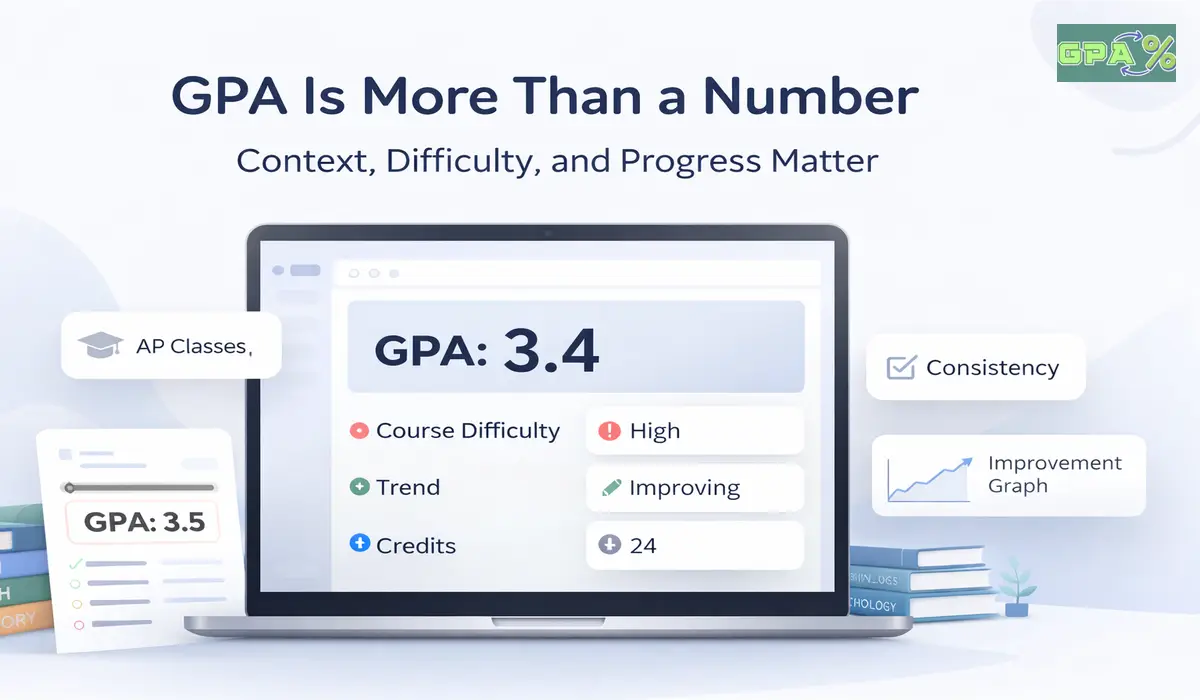
A GPA number by itself does not explain how that performance was achieved, which is why colleges and employers look beyond the number and try to understand the full academic record.
Course difficulty plays a major role in this evaluation. A slightly lower GPA earned in advanced classes such as honors, AP, or IB courses can carry more weight than a higher GPA earned in less demanding coursework.
NACAC reports that grades in challenging courses remain one of the strongest admission factors. Your extent of consistency also matters because a GPA that improves over time usually reflects stronger academic discipline than one that stays the same or declines.
Weighted vs Unweighted GPA Reality
In high school, GPA can appear in two forms, weighted and unweighted, and this often creates confusion when comparing results.
Unweighted GPA follows a standard 4.0 scale where all courses carry the same value, while weighted GPA assigns higher values to advanced courses such as honors or AP classes. A higher weighted GPA does not automatically mean a stronger profile, because colleges review both the scale and the course rigor before making comparisons.
GPA and College Type Expectations
Different colleges operate at different levels of competition, which means GPA expectations also change.
Community colleges often accept students with a GPA in the 2.0 to 3.0 range, while many state universities expect a GPA closer to 3.0 to 3.5. More selective colleges normally look for a GPA in the 3.5 to 3.8 range, and top universities often see applicants with a GPA above 3.8.
These are not strict cutoffs, but they provide a realistic picture of how GPA expectations shift depending on the institution.
Why Comparing GPA With Others Does Not Work
A comparison of GPA with other students creates confusion because the numbers do not always reflect the same level of effort or academic difficulty.
Different schools follow different grading systems, and the level of course difficulty also changes from one place to another. A GPA that looks lower in one school can still come from harder subjects, while a higher GPA in another school may come from easier coursework.
Real Situations That Show the Difference
A student with a 3.2 GPA who shows improvement constantly across semesters may present a stronger academic pattern than a student with a 3.8 GPA who does not change over time.
Another student with a 3.5 GPA in advanced courses may be in a better position than someone with a slightly higher GPA earned in less demanding classes. These differences become important when transcripts are reviewed in detail.
What Matters Along With GPA
A GPA is one part of your academic record, but it does not give the full picture of your performance.
Colleges and employers look at what type of subjects you studied and how difficult those subjects were. A student who takes advanced or honors classes is judged differently from someone who chooses easier courses, even if the GPA number looks similar.
Your consistency across semesters is also checked. If your marks stay stable or show steady effort, it gives a clearer idea of your study habits. Sudden drops or uneven results can raise questions about performance during that time.
Improvement over time is another point that is noticed. If your GPA starts lower and gradually increases, it shows that you adjusted, learned, and handled your studies better as time passed.
Your overall academic engagement also matters. Participation in class, project work, assignments, and how actively you stay involved in learning are all considered along with your GPA.
All these details together give context to your GPA and show how your academic journey actually looks beyond just one number.
Quick GPA Reference
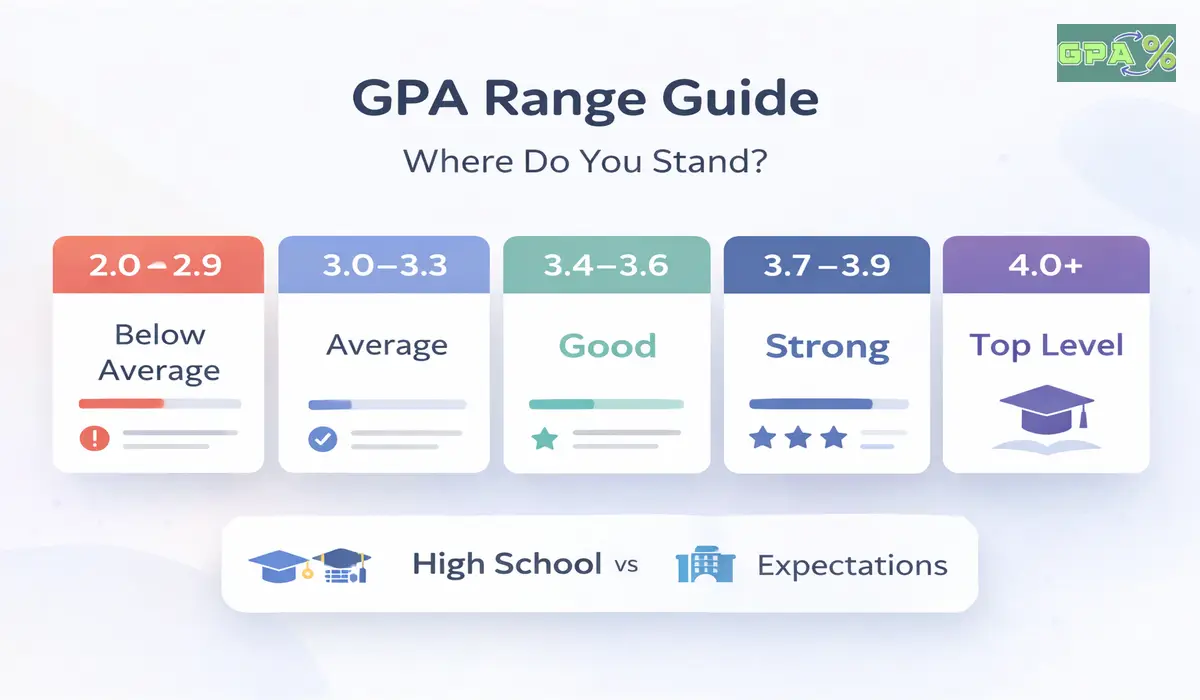
| GPA Range | Meaning |
|---|---|
| 2.0–2.9 | Below average |
| 3.0–3.3 | Average |
| 3.4–3.6 | Good |
| 3.7–3.9 | Strong |
| 4.0+ | Top level |
If Your GPA Is Not Where You Want It
A GPA that is lower than expected does not mean that future options are closed, because GPA changes over time based on performance in upcoming semesters. A strong set of grades in the next term can begin shifting the overall pattern, even if the change is gradual.
A better approach is to pay attention to higher credit courses and maintain consistency across semesters, which can create visible improvement over time and matter as much as the final number.
FAQs
Is a 3.0 GPA good?
A 3.0 GPA is considered average in most schools and is acceptable for many colleges. It may not be competitive for selective institutions without additional strengths.
Is a 3.5 GPA good?
A 3.5 GPA is considered strong in both high school and college. It makes a student competitive for many academic and career opportunities.
Is a 4.0 GPA required?
A 4.0 GPA is not required for most colleges. Many students are admitted with lower GPAs when other parts of their profile are strong.
What GPA do colleges want?
Most colleges look for a GPA between 3.0 and 3.5, while more competitive schools expect higher ranges. The requirement depends on the institution and program.
Conclusion
A good GPA is not defined by a single number but by how that number fits within your academic path, the difficulty of your coursework, and the direction your performance is taking over time. The same GPA can carry very different meanings depending on these factors.
When GPA is viewed in this context, it becomes easier to understand where you stand and what steps can move you forward, without relying on comparisons that do not reflect your actual situation.