A student chooses an AP class with the idea that it will push the GPA higher, but the result does not come from the course name alone and instead depends on how the school calculates grade points, how many credits the course carries, and what grade finally appears on the transcript.
This is where confusion usually starts, because the effort feels higher while the number does not always move in the same direction.
Many students expect a direct increase, yet the calculation works through a system where grades, credits, and scale all combine, so the outcome only becomes clear once these parts are looked at together rather than separately.

Do AP Classes Increase GPA?
AP classes increase GPA in schools that use a weighted GPA system, where advanced courses receive extra grade points, while the same classes do not change GPA in an unweighted system, where every course follows the same 4.0 scale regardless of difficulty.
The important point here is that the increase does not come from taking the course itself, but from how the school converts that course into grade points during GPA calculation.
What AP Classes Are?
AP classes are Advanced Placement courses designed by the College Board, and they follow a standardized syllabus that aligns more closely with college-level coursework than regular high school classes, which is why the pace, expectations, and volume of content are noticeably higher across the term.
These courses are not simply harder versions of regular classes because they are structured to match college-style evaluation, which means assignments, tests, and grading carry a different level of pressure compared to standard classes.
How AP Classes Affect GPA?
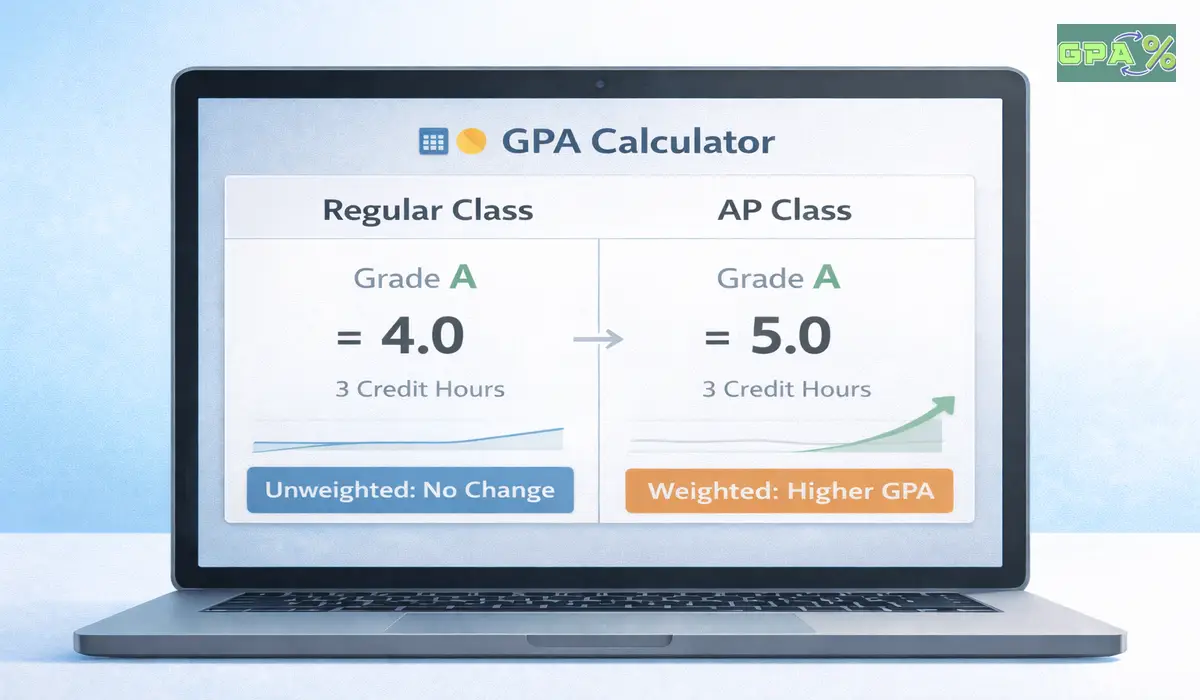
In a weighted GPA system, each letter grade is converted into a higher value when it comes from an AP course, so an A that normally counts as 4.0 may be recorded as 5.0, while a B that normally counts as 3.0 may be recorded as 4.0, and these higher values increase the total quality points once they are multiplied by credit hours and added to the cumulative GPA.
| Grade | Regular | Honors | AP |
|---|---|---|---|
| A | 4.0 | 4.5 | 5.0 |
| B | 3.0 | 3.5 | 4.0 |
| C | 2.0 | 2.5 | 3.0 |
When several courses follow this pattern across a semester, the added points begin to show a visible difference in the overall GPA, especially when higher credit subjects are involved in the calculation.
Weighted vs Unweighted GPA
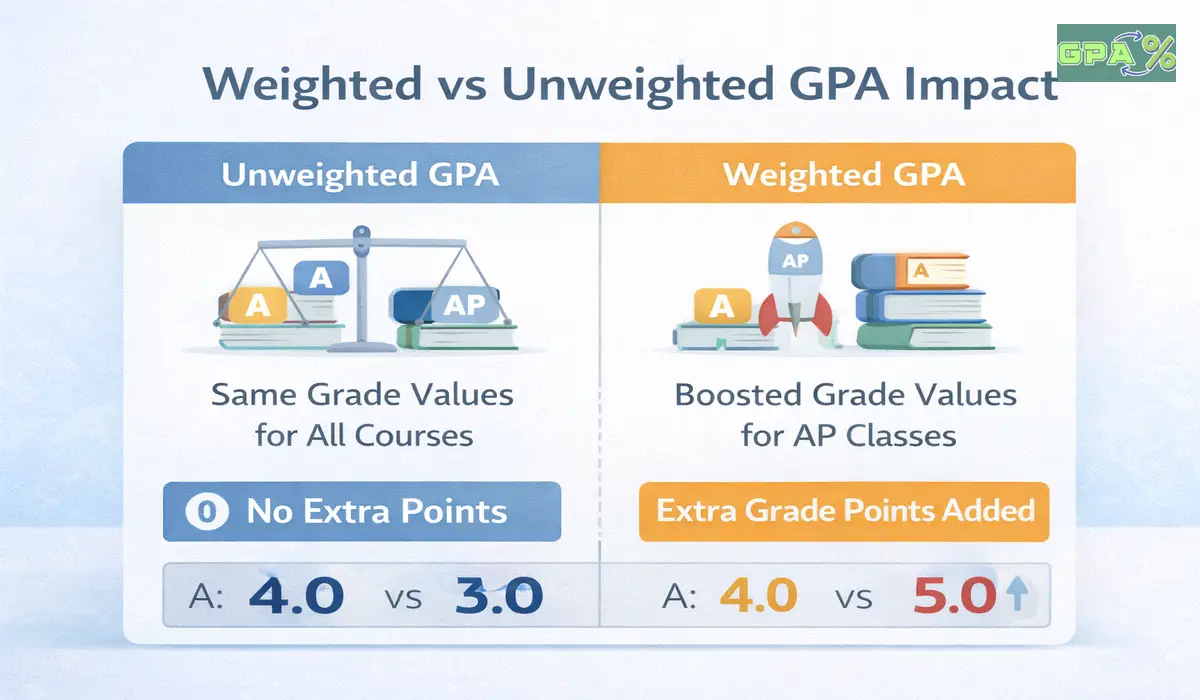
The effect of AP classes changes completely depending on the grading system used by the school, because an unweighted GPA keeps the same value for every course and does not consider difficulty, while a weighted GPA assigns additional points to advanced courses and allows them to contribute more to the final number.
| GPA Type | AP Impact |
|---|---|
| Unweighted | No change in GPA value |
| Weighted | Higher GPA due to added points |
Some schools use variations such as 4.5 or 5.0 scales, which means the same AP class can produce slightly different results depending on how the system is structured.
When AP Classes Actually Increase GPA?
A noticeable increase happens when the grading system supports weighted values and when the grade earned remains high enough to take advantage of the additional points, because the calculation multiplies the grade value by credit hours and adds it to the total, so both factors must work together.
When a student secures high grades in AP courses that carry more credit hours, the effect on GPA is more noticeable because those grades contribute a larger share to the total calculation, and when this level of performance is repeated across several subjects within the same term, the combined impact starts reflecting clearly in the overall average.
When AP Classes Do Not Help
The advantage of an AP class disappears when the grade drops to a level where the extra weight cannot compensate for the lower value, because the final GPA depends on total quality points rather than course labels.
No improvement is seen in schools that use only unweighted GPA, and a heavy schedule filled with difficult courses can also reduce the average if grades fall across multiple subjects.
Real Example That Changes the Result
Consider two situations where one student earns an A in a regular class while another earns a B in an AP class, and both results convert to the same grade points in a weighted system, which shows that course level alone does not create a higher GPA unless the grade remains strong.
This kind of comparison explains why some students take advanced courses yet see no improvement, because the calculation always depends on the final grade rather than the effort involved.
Honors vs AP Classes
AP classes usually add about one full grade point in a weighted system, while honors classes add about half a point, which means AP courses carry a higher potential impact on GPA when grades remain consistent across the term.
This difference is more visible when multiple advanced courses are taken together, although the final outcome still depends on how well each subject is handled.
How Colleges View AP Classes?
Colleges review the transcript as a complete record and look at both the level of courses and the grades earned in them, so AP classes indicate that a student chose a more demanding path. NACAC also lists grades in challenging courses among the most important admission factors, but the evaluation still depends on performance within those courses.
Many colleges also adjust GPA during admission review to create a consistent comparison across applicants, which means the presence of AP classes adds context but does not guarantee an advantage without strong grades.
Should You Take AP Classes?
A decision to take AP classes depends on whether the workload can be managed without lowering grades in other subjects, because a smaller number of advanced courses with strong results usually creates a better outcome than a heavier schedule that reduces overall performance.
Balance across subjects plays a major role here, since GPA is calculated from all courses together rather than from one subject alone.
Common Mistakes Students Make
- Assuming AP classes automatically increase GPA
- Taking too many AP courses without considering the grade impact
- confusing AP exam scores with course grades
- Comparing weighted GPA with unweighted GPA without context
These mistakes usually come from focusing on the course level instead of understanding how GPA is calculated.
Use a GPA Calculator to Compare Scenarios
A GPA calculator allows different scenarios to be tested by entering course credits and expected grades, which makes it possible to see how an AP class compares with a regular class before the semester ends.
This approach removes guesswork and shows how each decision affects the final number.
FAQs
Do AP classes raise GPA?
AP classes raise GPA in weighted systems because they carry higher grade points, while unweighted systems do not change the number.
Is AP better than honors for GPA?
AP classes usually create a higher GPA impact than honors classes, although the final result still depends on the grade earned.
Do AP exam scores affect GPA?
AP exam scores do not affect GPA because GPA is calculated from course grades, not from exam results.
How much does AP increase GPA?
AP classes can add about one extra grade point in weighted systems, although the exact impact depends on the grading scale used by the school.
Conclusion
The effect of AP classes on GPA comes down to how the grading system is set up and what grades are actually earned in those courses, because in a weighted system, the extra points can raise the overall number when performance stays strong, while in an unweighted system, the same classes are counted like any other subject and do not change the GPA.
In both cases, the final result is shaped by how grade points and credit hours add up across the full transcript rather than by the course label itself