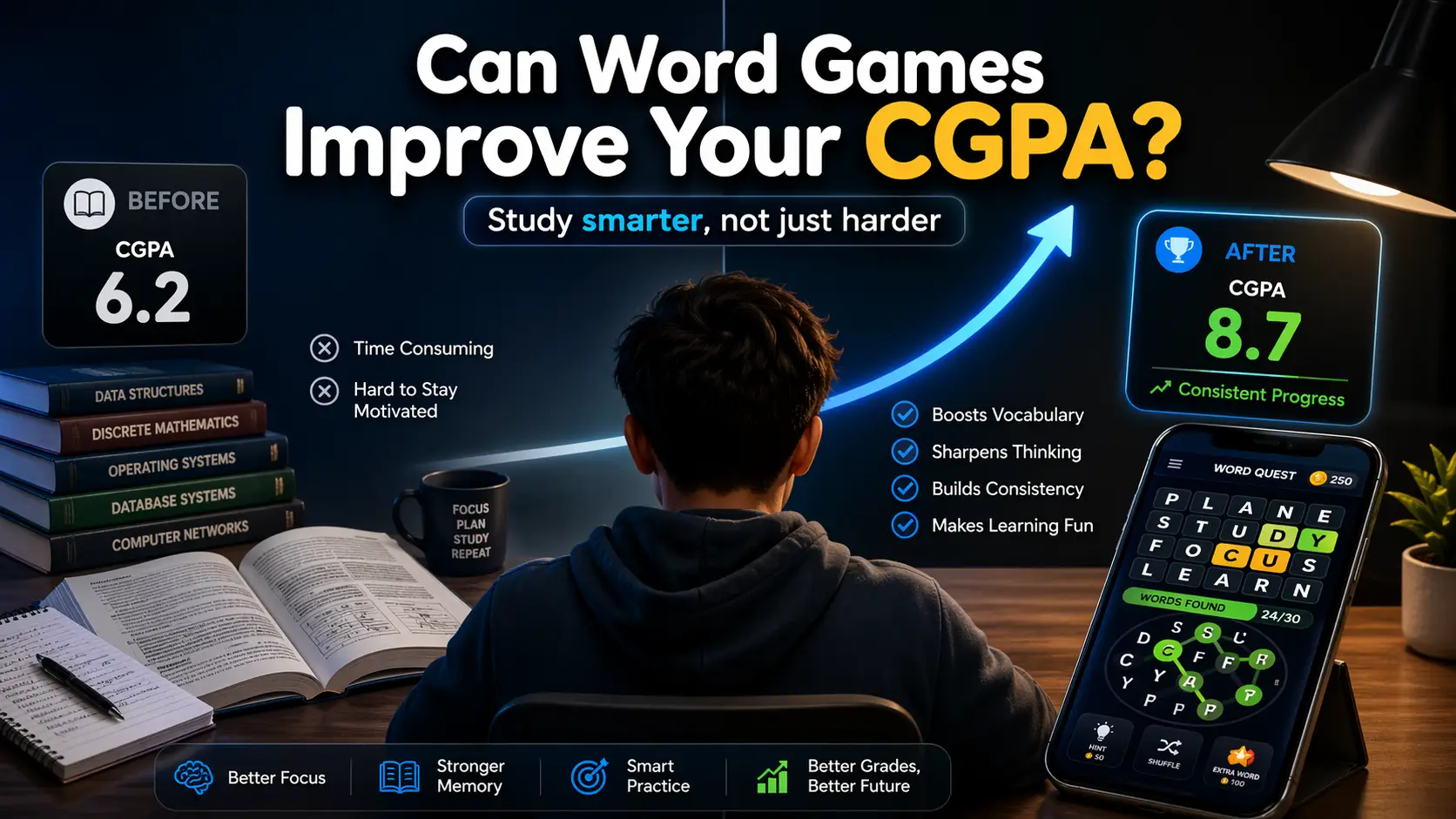
The majority of students view the two as opposite entities, as if you either sit and study your books or squander time on the phone. But no one speaks of the middle ground, that place where each can occur simultaneously, and you may never be aware of it. Much of the best learning occurs when the brain is not under pressure, and games provide just that.
This is not about substituting your courses with Candy Crush. It’s about learning to play some games quietly, especially word games. They can achieve the same goals as your textbooks, but without the stress. And when that bond goes, your vocabulary expands, your writing becomes sharp, your grades on exams increase, and the CGPA does too.
We ought to divide this down.
Why CGPA Suffers Even When Students Study Hard
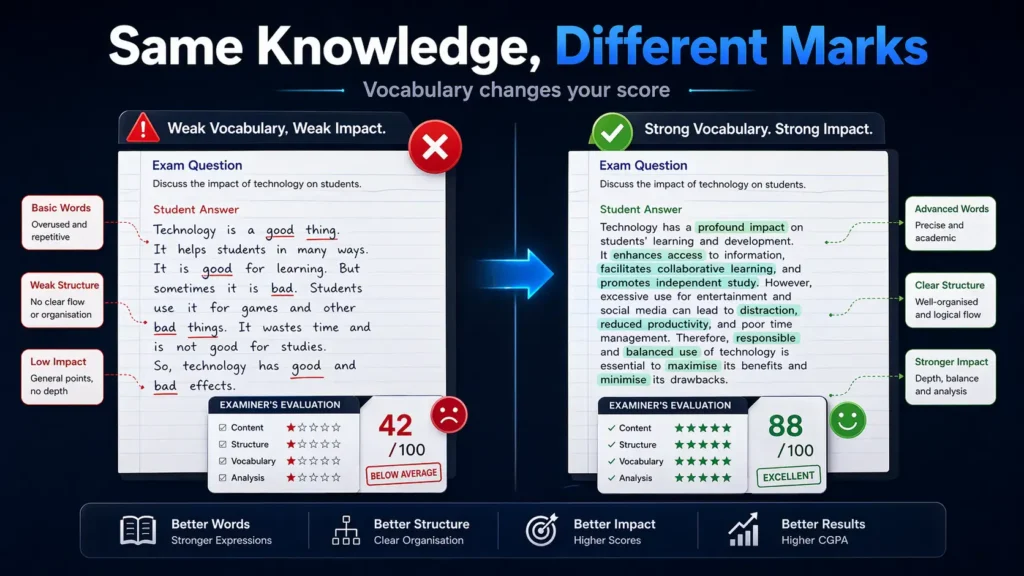
Students usually work the hours, but still fail to get the scores they want. Poor vocabulary is one of the reasons that is underestimated. One can be able to comprehend one thing fully but fail to put it on paper using the correct words; the examiner can fail to award you the full points. It is this lack of knowledge to articulate what one has learned that keeps a large number of students back.
A strong vocabulary directly affects reading comprehension, essay writing, exam answers, and classroom discussions.
As per research by the Education Endowment Foundation on oral language and learning outcomes, students who build strong word knowledge tend to perform better across subjects, not just English. The reason is clear. Academic language appears in every subject. You see it in math word problems, in science case studies, and in law questions. If you are not comfortable with these words, you can lose marks even when you understand the concept. In many cases, you may not even realise what went wrong.
How Games Actually Teach Without Feeling Like Teaching
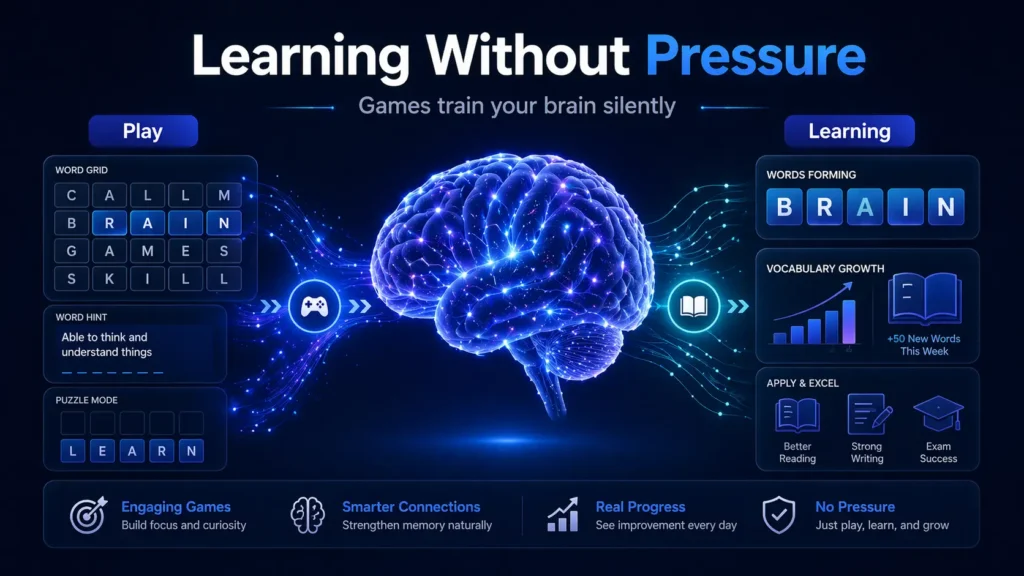
Games introduce a sense of relaxation and fun, thereby enabling learners to memorize words more easily. They have some degree of common competence that keeps the gamers engaged and injects real-world into the learning system. It is not my personal viewpoint; it is what scientists who study the development of vocabulary have said for a long time.
Students who played word games to learn had better vocabulary skills than those taught with traditional methods. This means word games are a great way to teach vocabulary.
The most important thing is engagement. You are playing, and your brain is scanning actively into patterns, it’s making decisions, linking letters and meanings. This is exactly the thinking exercise that traditional flashcard methods try to replicate. However, they often fail for most learners.
The interactive play helps students clear up misunderstandings. It does this without embarrassing or isolating them, unlike classroom corrections. This makes it much more comfortable than being corrected in class.
Word Games That Actually Work for Students
Not all games are created equal. Some just pass the time. Others build real skills. Here are the types worth your attention.
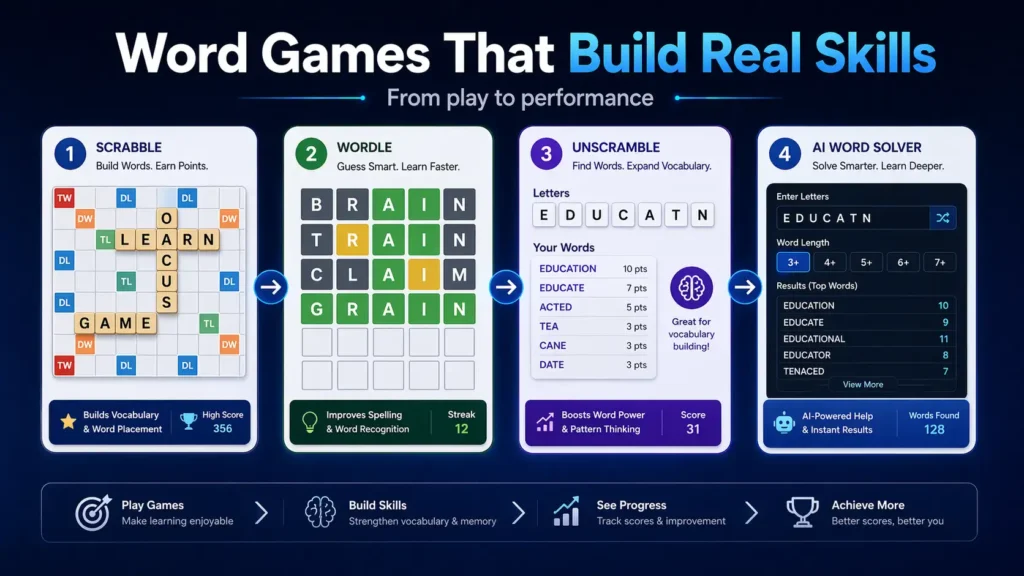
Scrabble and Similar Tile Games
Scrabble forces you to think about word structure. You have a set of random letters, and you need to form valid words from them. Over time, you naturally start recognizing prefixes, suffixes, and root words without studying them formally. This matters a lot in exams where unfamiliar academic words show up. If you know that “cred” relates to belief and “bio” relates to life, you can figure out words you’ve never seen before.
Wordle and Daily Word Challenges
Wordle became popular because it’s short, satisfying, and mentally engaging. Five letters, six guesses, one word per day. But what it actually does is train your brain to eliminate wrong patterns and think logically about word structure. That’s a critical thinking exercise disguised as a 5 minute game.
Word Unscramble & Crossword Puzzles
Word unscramble and crosswords turn jumbled letters into a fun puzzle challenge, training you to spot patterns, prefixes, and roots on the fly. Enter scrambled letters (like “AETRNS”) and rearrange them into valid words. They are like Scrabble but solo and speedy. This builds instant recognition of word structures you can use in essays or exams.
Tools like AI Word Solver supercharge this by offering a free and easy way to unscramble your scrambled letters. You input letters, and it reveals every possible word with definitions, which expand your vocabulary beyond what you’d find alone. Students who play regularly notice patterns faster, turning passive knowledge into active skills for better writing and comprehension.
That passive vocabulary becomes active over time and shows up in your writing and comprehension scores.
The Direct Connection Between Word Knowledge and CGPA
Strong vocabulary is one of the biggest predictors of academic success. Students often know what they want to say, but they struggle with academic language. This gap can impact their grades, test scores, and confidence.
Think about your last assignment. How many times did you use a general word like “good” or “bad” when a more precise word would have made your argument stronger? Examiners in universities notice this.
The difference between a B and an A in many essay-based subjects is often the ability to use specific, well-chosen words. It shows depth of understanding.
Good vocabulary is a benefit that helps students develop their vocabulary in more complex subjects as they advance in school. This builds up as time progresses. Students who acquire vocabulary in the first semester will find courses in the second year easier. This is not because they are smarter at studying, but because they have a better understanding.
How to Actually Use This in Your Daily Routine
The point isn’t to play games instead of studying. It’s to use short, focused word game sessions as a complement to your regular study habits. Here’s a realistic way to do it.
Spend 10 to 15 minutes on a word game during your break instead of scrolling social media. This keeps your brain active without exhausting it. When you encounter a word you don’t recognize during a game, look it up.
One new word per session adds up to hundreds over a semester. Use AI Word Solver whenever you feel stuck in a word puzzle. It doesn’t just give you the answer; it shows you the full range of words possible from those letters, along with their definitions.
That exposure builds vocabulary faster than traditional study lists.
If you play games like Scrabble online or in group settings, challenge yourself to use higher point value, less common words. The process of attempting to use them cements them in memory far better than reading them in a word list.
Frequently Asked Questions
1. Will playing word games really improve my CGPA?
Yes, research shows students who build vocabulary through games see gains in reading, writing, and even math/science word problems. It’s not a magic fix, but it sharpens expression, helping you score higher on essays and exams.
2. How much time should I spend on games daily?
Only aim for 10-15 minutes during breaks, replacing social media scrolls. That’s enough to learn 1-2 new words per session, adding up to 100+ over a semester without cutting into study time.
3. Which game should I start with as a beginner?
Try Wordle or Scrabble. They are free, quick, and train your brain on pattern recognition. There might be a possibility that you get stuck in finding a valid word, and using AI Word Solver can help you in word building and improving vocabulary.
Final Thoughts
Studying harder is not enough to boost your CGPA. It increases with greater clarity of understanding, expression, and confidence in academic language. Word games are among the least common ways to make that happen because they do not relate to studying. Start small. One game a day. One new word per session. Students who learn vocabulary through games, reading, and writing tend to perform better than those who learn it through rote memorization. You already spend time on your phone. You could even count some of it.