A college transcript can change in ways that surprise you, especially when one semester goes well, but the GPA does not move as much as you expected, or when a single low grade pulls the number down more than you thought it would. This usually happens because college GPA is not a plain average of your grades, and the real calculation depends on credit hours, grade points, and the academic rules your college uses.
Many students understand the final number only after they sit with a transcript, look at each course one by one, and notice that a 4 credit class carries much more weight than a 1 credit lab or seminar.
Once that structure becomes clear, a college GPA calculator stops looking like a convenience tool and starts becoming a practical academic planning tool that helps you check semester GPA, cumulative GPA, and future grade scenarios with much better accuracy.

What College GPA Actually Means
College GPA is a numeric summary of your academic performance across graded college courses, and colleges calculate it by assigning point values to your letter grades and then weighting those values according to credit hours. This method creates a more accurate record of performance because a course with more credits affects GPA more than a course with fewer credits.
A college transcript usually shows two main GPA values. Semester GPA reflects performance in one term only, while cumulative GPA reflects performance across all completed terms. Both numbers matter because one shows recent academic progress and the other shows overall academic consistency.
Key Terms You Should Understand First
College GPA becomes much easier to understand when the main calculation terms are clear from the beginning.
Credit Hours
Credit hours represent the academic weight of a course. A 4 credit course usually carries more influence in GPA calculation than a 1 credit course because it counts more in the total credit load.
Grade Points
Grade points are the numeric values assigned to letter grades such as A, B, or C. These values depend on the grading scale used by the college, which is commonly a 4.0 scale, though some colleges use slight variations.
Quality Points
Quality points are calculated by multiplying the grade point value by the credit hours of the course. This number is the foundation of GPA calculation because colleges add all quality points together before dividing by total credit hours.
The table below shows how these terms work together.
| Term | Meaning | Why It Matters |
|---|---|---|
| Credit Hours | The academic weight of a course | Determines how much a class affects GPA |
| Grade Points | Numeric value of a grade | Converts letter grades into GPA values |
| Quality Points | Grade points multiplied by credits | Used to calculate final GPA |
College GPA Formula
The standard college GPA formula is straightforward once the course data is organized correctly.
GPA = Total Quality Points ÷ Total Credit Hours
This means you first convert each grade into grade points, then multiply that value by the credit hours of that course, then add all quality points together, and finally divide the result by the total credit hours. Colleges use this method because it reflects both academic performance and course weight instead of treating every class as equal.
How to Calculate College GPA Step by Step
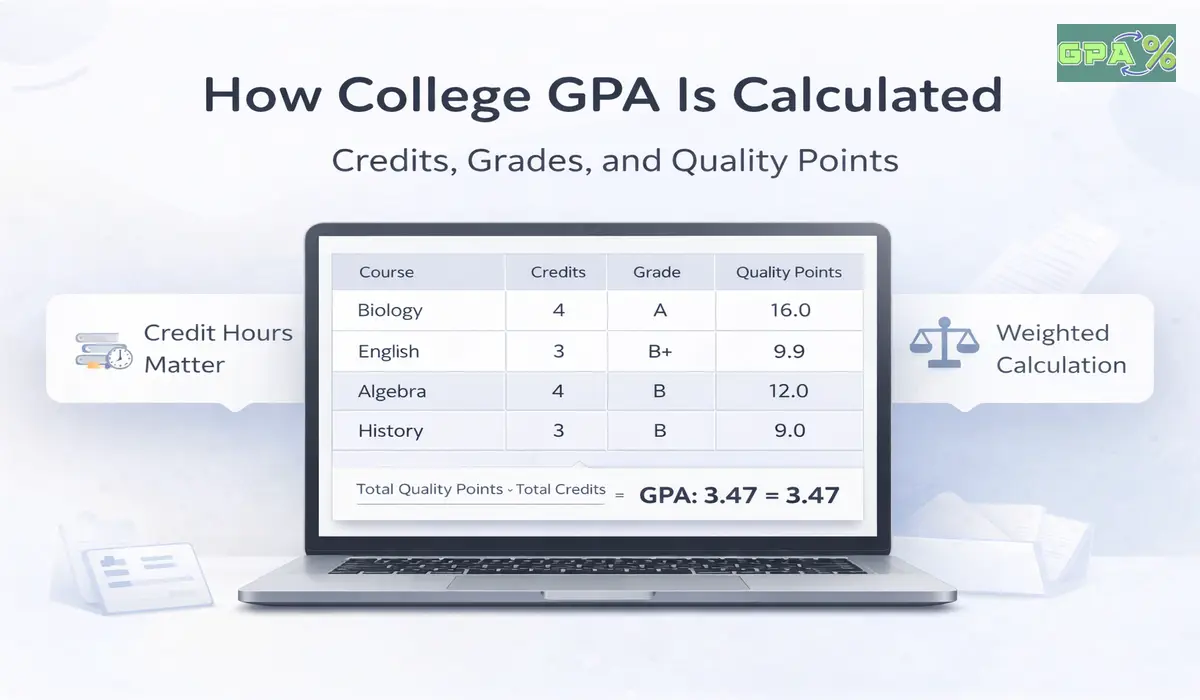
A structured process makes the calculation much easier to follow.
- List every graded course from the term or from all completed terms
- Note the credit hours and letter grade for each course
- Convert each letter grade into grade points
- Multiply grade points by credit hours to get quality points
- Add all quality points and divide by total credit hours
This process works for both semester GPA and cumulative GPA, as long as you include the correct set of courses.
Real College GPA Example
A full example shows why GPA does not move in a perfectly even way across courses.
| Course | Credits | Grade | Grade Points | Quality Points |
|---|---|---|---|---|
| Biology | 4 | A | 4.0 | 16.0 |
| English Composition | 3 | B+ | 3.3 | 9.9 |
| College Algebra | 4 | B | 3.0 | 12.0 |
| Psychology | 3 | A- | 3.7 | 11.1 |
| Lab Seminar | 1 | B | 3.0 | 3.0 |
Total quality points = 16.0 + 9.9 + 12.0 + 11.1 + 3.0 = 52.0
Total credit hours = 4 + 3 + 4 + 3 + 1 = 15
GPA = 52.0 ÷ 15 = 3.47
This example shows why a strong grade in a high credit class changes GPA more than a similar grade in a low credit course. A 1 credit course still matters, but its impact is much smaller compared with a 4 credit class.
Semester GPA vs Cumulative GPA
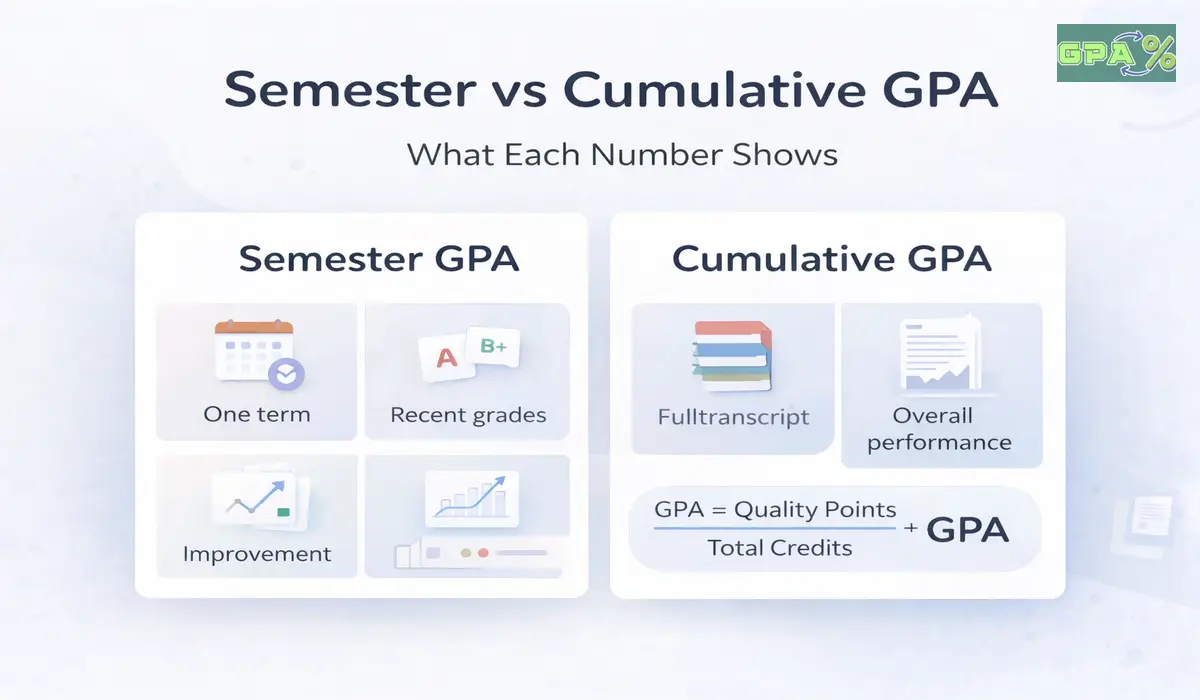
Students often see both of these numbers on their transcripts and assume they serve the same purpose, but each one answers a different question.
| GPA Type | What It Shows | When It Is Used |
|---|---|---|
| Semester GPA | Performance in one term | Academic progress for the recent semester |
| Cumulative GPA | Performance across all completed terms | Overall academic standing and long range review |
Semester GPA becomes important when you want to understand how one recent term changed your record. Cumulative GPA becomes more important when colleges, scholarship committees, or academic advisors review your full academic history.
How Credit Hours Change GPA
Credit hours are one of the biggest reasons students misread their college GPA. Two courses can have the same grade, but the higher credit course will change the GPA more because it contributes more quality points to the final calculation.
The comparison below makes this easier to understand.
| Course | Credits | Grade | Grade Points | Quality Points |
|---|---|---|---|---|
| History | 4 | B | 3.0 | 12.0 |
| Music Elective | 2 | B | 3.0 | 6.0 |
The letter grade is identical in both courses, but the 4 credit class contributes twice as many quality points. This is why college students should pay close attention to credit load while planning recovery after a low grade or while estimating the impact of a strong semester.
What Courses Are Usually Included in College GPA
Most graded academic courses are included in GPA, but not every line on a transcript is treated the same way. Standard letter graded courses are usually counted, and failed courses usually count as well because they still carry grade points, even if the value is zero.
Some courses may not count in the same way. Pass or fail courses, withdrawals, incompletes, and non-credit academic activity may follow separate rules depending on college policy. This is why the transcript guide, registrar’s office, or academic handbook becomes important when you are checking your official GPA against your own calculation.
How Repeated Courses Can Change GPA
Repeated courses are one of the most common sources of confusion in college GPA. A student may retake a class after receiving a low grade and assume that the old grade disappears completely, but colleges do not all follow the same policy.
Some colleges replace the earlier grade with the new grade for GPA purposes, while some colleges keep both attempts on record and calculate GPA according to their own repeat policy. This difference matters a lot because a repeated 4 credit class can change cumulative GPA in a noticeable way. You should always review your college’s repeat course policy before assuming how the transcript will be updated.
Why Manual Calculation Creates Confusion
Manual GPA calculation works well when you are learning the process or checking a small number of courses, but the chance of error rises quickly when a semester includes many classes, mixed credit hours, repeated courses, or several grading rules.
A small mistake in one grade value or one credit entry can change the final GPA enough to give you a wrong picture of your academic standing.
Rounding also creates problems. Some students round each course result too early instead of keeping the exact quality points until the final step, and that creates a slightly incorrect GPA.
A college GPA calculator removes much of this confusion because the inputs stay organized and the full calculation stays consistent.
How a College GPA Calculator Helps
A college GPA calculator gives you a structured way to enter courses, credit hours, and grades without rebuilding the formula every time you want to check your result. This becomes especially useful when you are calculating one term, updating cumulative GPA, or testing future semester goals.
- It organizes course grades and credits in one place
- It reduces calculation errors that happen in manual math
- It makes semester and cumulative GPA checks much faster
- It supports academic planning before final grades arrive
A calculator becomes more valuable when your college schedule is heavy or when you are trying to recover from one weak semester through better planning in the next term.
How to Use a College GPA Calculator Correctly
A GPA calculator gives the best result when the course information is entered carefully, and in the same format your college uses.
Step 1: Enter Each Course
List all courses from the semester or all courses needed for a cumulative GPA check. Make sure the course list matches the actual graded classes on your transcript.
Step 2: Add Credit Hours
Enter the correct credit hours for each course. This part matters because GPA depends on course weight, not just on grades.
Step 3: Choose the Right Grades
Select the letter grade exactly as it appears in the system used by your college. A small difference, such as A versus A minus, changes the grade point value and affects the final GPA.
Step 4: Review the Result Carefully
Check the semester GPA, cumulative GPA, or scenario result after calculation. If your result differs from the official transcript, compare the course inclusion rules, repeated class policy, and grading scale.
Scenario Planning for Future Semesters
One of the most useful parts of a college GPA calculator is the ability to test future outcomes before the semester ends. This is important when you are trying to reach a scholarship requirement, maintain academic standing, or estimate what grades are needed to move your cumulative GPA upward.
A student with a 3.18 cumulative GPA may want to know how much the number can rise after a 15 credit semester with strong grades.
Instead of guessing, the calculator can show the effect of different grade combinations with much more accuracy. This gives you a practical academic planning tool rather than just a final score tool.
The table below shows a simple planning example.
| Scenario | Credits Next Term | Expected GPA Next Term | Likely Effect |
|---|---|---|---|
| Moderate Recovery | 15 | 3.3 | Small cumulative improvement |
| Strong Semester | 15 | 3.7 | Clear cumulative rise |
| Excellent Semester | 15 | 4.0 | Strongest improvement possible |
A planning view like this becomes useful when you are deciding how much improvement is realistic in one term instead of expecting one semester to repair everything at once.
Common Mistakes College Students Make
- Ignoring credit hours and treating GPA as a plain average of grades
- Using the wrong grade point mapping for the college’s grading scale
- Mixing semester GPA and cumulative GPA in one calculation
- Assuming repeated, pass, or fail courses follow the same rules everywhere
These mistakes create wrong expectations and can also create unnecessary worry when transcript numbers do not match manual calculations.
What Is a Good College GPA
A good college GPA depends on the student’s goals, major, scholarship requirements, and transfer or graduate school plans, but there are still some useful reference points.
A GPA around 3.0 is often seen as a solid average in many colleges, a GPA around 3.5 is usually considered strong, and a GPA above 3.7 can become more competitive for selective academic opportunities.
The number should not be viewed in isolation. Course load, major difficulty, and academic improvement over time also matter. A student with a rising GPA after a difficult first year may present a stronger academic story than the number alone suggests.
How College GPA Appears on a Transcript
A college transcript usually records each course, its credit hours, the final grade, and the GPA summary for the term and the full record. This official document is what advisors, scholarship offices, transfer institutions, and graduate admissions teams review.
A registrar’s office manages the official transcript rules, which is why the transcript is always the strongest source when you want to confirm whether a course counts toward GPA, whether a repeated class changed the result, or whether a grading symbol affects the final number.
Why This Guide Matters for Academic Decisions
A college GPA calculator is useful, but the real value comes from understanding what the number means before you use the tool. When you know how credit hours, grade points, and transcript rules work together, you can make smarter decisions about course planning, semester recovery, and academic goals.
That knowledge becomes especially important when you are trying to maintain eligibility, improve academic standing, or decide whether one more strong semester can realistically change your cumulative GPA. A calculator gives the number, but understanding the structure gives you control over the decision.
Related Guides
- What is GPA, and how does it work in the US
- How to calculate GPA step by step
- 4.0 GPA Scale Explained
- 4.33 GPA Scale Explained
FAQs
How do I calculate college GPA?
College GPA is calculated by dividing total quality points by total credit hours. Quality points come from multiplying the grade point value of each course by its credit hours.
What is a semester GPA in college?
Semester GPA shows your academic performance for one term only. It reflects the grades and credit hours from that semester, not your full college record.
What is a cumulative GPA in college?
Cumulative GPA shows your academic performance across all completed college terms. It becomes the main long range number on your transcript.
How do credits affect college GPA?
Credits determine how much each course changes the final GPA. A high credit course has more impact than a low credit course with the same grade.
Conclusion
College GPA is not a rough estimate of grades but a structured academic calculation where credit hours, grade points, and transcript rules all work together to produce the final number. Once you understand that structure, the result on your transcript becomes much easier to interpret and much easier to improve through deliberate course planning.
A college GPA calculator becomes most useful when it is paired with that understanding because it allows you to check semester results, cumulative progress, and future scenarios with accuracy instead of guesswork. That combination gives you a much stronger foundation for academic planning, transcript review, and long term college decisions.