
You’ve been looking at online MCA courses for a few days. One university has a course that fits your budget. Another offers a specialization you like. You can attend classes without leaving your job, which is probably the biggest reason you’re considering an online degree in the first place.
But there’s something you want to be sure about before paying the fees.
Will an IT company accept the degree when you apply for a job? Or will HR reject it because you studied online instead of attending college?
The answer is yes: an online MCA is a valid postgraduate degree in India when the university has UGC entitlement to offer that particular programme. Under UGC rules, eligible online degrees have the same academic standing as the corresponding regular degrees.
That answers the question about degree validity. It doesn’t mean every employer follows identical hiring rules, though.
What Actually Happens When You Apply for an IT Job?
Look at a few software developer vacancies on LinkedIn or Naukri. Some companies ask for an MCA or B.Tech. Others mention a bachelor’s degree and a certain number of years of experience.
You won’t find one common education rule for every IT job.
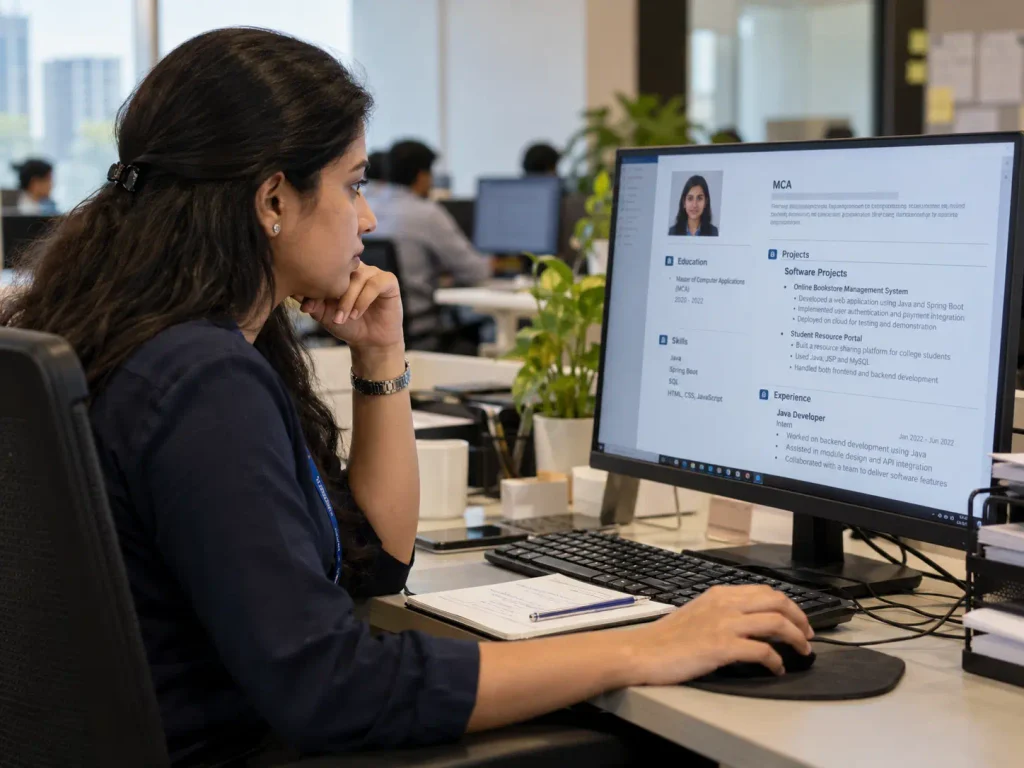
Let’s say a company is hiring a Java developer with two years of experience. The recruiter opens your resume and sees your MCA, your university, and the projects you’ve worked on.
If the vacancy accepts an MCA and doesn’t restrict the mode of education, your recognised online degree would normally meet that academic requirement.
But the recruiter still has to decide whether your experience fits the position.
Someone who has spent two years working on Java applications has actual work to discuss. A fresher who only lists Java in the skills section is in a different position. Both might have the same degree, but they aren’t applying with the same experience.
That difference can affect who gets called for an interview.
Your resume doesn’t need a long explanation about studying online. Mention the qualification, full university name and year of completion. If the application form specifically asks how you studied, select the correct option.
And spend some time describing your projects.
If you worked on an API, explain what it was used for and which part you built. A project that involved fixing a slow database query is also worth mentioning. You don’t need to claim a 40 percent improvement unless you’ve actually measured it.
The recruiter wants to understand what you can do.
One thing to remember is that not every company uses the same software to screen resumes. Some employers ask for the mode of education in their application forms, while others don’t. So it’s not correct to say that online education is never considered during the first stage.
The Technical Interview Is a Different Story
You’ve been shortlisted for a developer position. The interviewer asks you to write a function that solves a programming problem.
At that moment, your MCA is not going to write the code.
You still have to understand the question and explain your answer. If you’re applying for a job involving databases, you might be asked about SQL queries. An experienced developer could be asked to explain why a particular application was designed in a certain way.
Some companies also include system design questions for senior positions.
Whether you studied online or on a college campus doesn’t tell the interviewer how well you understand these subjects. A regular MCA graduate can be weak in programming. An online graduate can be good at it.
For working developers, studying alongside a job has one useful advantage.
You might be learning about database indexing while working on an application that takes too long to fetch records. Now you have a chance to connect the lesson with something you’ve actually seen.
Perhaps you’ve already dealt with the same problem at work but didn’t understand the technical reason behind it. The course gives you a chance to study that part properly.
Not every subject will be related to your office work. You might spend most of your day building websites and still need to practise data structures separately.
If you’re new to IT, projects can help you prepare. Build a small application instead of relying entirely on university assignments. When the interviewer asks why you used a particular database or how your code handles an error, you should be able to explain it.
There’s no need to build something unusually complicated. A simple project that works and that you understand properly is useful.
If your university gives results in CGPA but a job application asks for percentage, you can use a CGPA to Percentage Calculator to work out the conversion while checking the formula followed by your university.
Will There Be a Problem During Background Verification?
You’ve cleared the interview and HR has shared the offer letter. A few days later, you receive an email asking you to upload your degree certificate and marksheets.
For many students, this is when the online MCA question comes back.
The company might use a verification agency to check your educational records. The agency can contact the university to confirm that you were enrolled and that the degree was awarded. It might also compare the dates with the information on your resume.
A genuine online MCA from a properly entitled university has the same academic standing as its regular counterpart. That doesn’t stop an employer from checking whether your degree satisfies a condition mentioned in its hiring policy.
What can create trouble is incorrect information.
Maybe you entered the wrong passing year when applying for the job. Perhaps your name appears differently on your marksheets and degree certificate.
These things happen with regular degrees too.
If you’ve received marks in several subjects and want to know your total percentage, the Marks Percentage Calculator lets you calculate the result without manually dividing your total marks by the maximum marks.
But if there’s a mismatch, HR could ask for clarification before completing the verification. You might need to contact the university and get the correct records.
That’s why it makes sense to keep your documents ready. Save the semester marksheets and enrolment proof instead of depending on old emails. When you receive the provisional certificate or final degree, check that your details are correct.
There’s another problem that is far more serious than a document mismatch.
A university may be recognised by the UGC without having entitlement to offer every programme online. You need to check the actual MCA course for your admission session.
The UGC Distance Education Bureau publishes information about entitled institutions and programmes.
If you’re about to spend two years studying, take the time to check that record yourself. A university advertisement saying that it is recognised doesn’t answer every question about its online courses.
How This Could Work for Someone Who Already Has a Job
Rohan is 27 and works as a developer at an IT services company. He completed his BCA two years ago.
His job is going well enough, but some of the senior positions at the company require a master’s degree. He wants to qualify for those roles without resigning and returning to college.
So he looks into an online MCA.
One course he finds is the MCA from JAIN Online.
JAIN is a Deemed to be University with NAAC A++ accreditation. Its online MCA is described as a UGC entitled programme. The university also advertises 8 specializations, so Rohan looks through the available subjects before deciding which one fits his work.
He doesn’t need to choose a specialization just because it has a popular name. He already knows the kind of software he enjoys building, and he’d rather study something connected with that work.
The programme information mentions 38+ AI tools as well. He checks what those tools are and how they’re included in the course, instead of assuming that every tool mentioned in the brochure will be useful for his job.
Once he enrols, most of his weekdays remain the same. He goes to work and studies after office hours.
Weekends are less free than they used to be.
Sometimes he has an assignment due on Monday and a deadline at work on the same day. He has to manage both. There are also weeks when he doesn’t get as much study time as he planned.
It isn’t an effortless way to earn an MCA.
But he’s continuing to work while learning. When a university lesson relates to something he has handled in an office project, he can understand it from another angle.
He also spends time building small projects of his own. If the course introduces an AI tool, he can test it with practice material. He would still need to follow company rules before using such tools on office code or private information.
After two years, Rohan has completed the MCA. His total work experience has grown from two years to four.
Now suppose the company advertises a team lead position.
The new degree might satisfy the education requirement, provided the company accepts it under its promotion policy. But his manager will still want to know whether he can guide other developers and handle more responsibility.
There is no guarantee he’ll get the position.
Rohan is an imaginary example. His situation simply shows why someone who is already earning might choose an online MCA instead of leaving a job for regular college.
Students who receive letter grades sometimes find it difficult to understand how their overall GPA is calculated, especially when subjects carry different credit values. A GPA Calculator can help you calculate your grades without doing all the maths by hand.
What About Salary? Do Online MCA Graduates Get Less?
There isn’t a general salary rule requiring IT companies to pay less to someone with an online MCA.
Say you’re a Java developer earning ₹6 lakh a year. You complete the MCA and apply for a position at another company.
The recruiter will look at your experience and the work you’ve done. The company also has a salary budget for the position. Your existing pay may enter the discussion when you negotiate.
An online MCA doesn’t automatically put you in a lower salary category.
But it doesn’t guarantee a higher salary either.
Some people complete a master’s degree expecting an immediate pay increase at their current company. That isn’t always how promotions work.
If your employer requires an MCA for a particular position, finishing the degree could make you eligible. It doesn’t mean HR will increase your salary as soon as you submit the certificate.
You still have to qualify for the role.
If you’re studying mainly to get promoted, ask HR whether the company accepts a UGC entitled online MCA. It’s a simple question, and getting the answer before admission could save a lot of confusion.
Freshers Have Another Problem to Think About

Imagine you’ve just completed your BCA and are deciding between a regular MCA and an online one.
A regular college might have established placement arrangements with IT companies. You could get a chance to attend interviews through the college itself.
Online students don’t always have access to the same recruitment drives.
That means you might have to search for your first job through Naukri, LinkedIn or the careers pages of individual companies.
It doesn’t make your degree invalid. But finding interviews can take more effort when you have no work experience.
Before joining a university, find out what its placement assistance actually includes. Some help students prepare resumes and practise interviews. Others arrange recruitment opportunities.
Don’t assume these services are the same as a guaranteed job offer.
Can You Use an Online MCA for Government or PSU Jobs?
For government jobs, you need to read the recruitment notification carefully.
The UGC recognises eligible online degrees as equivalent to corresponding regular degrees. But individual government departments and Public Sector Undertakings can have specific conditions for a post.
One vacancy might ask for an MCA from a recognised university. Another could require a particular percentage or an additional qualification.
When filling out scholarship forms or college applications, you might be asked for your semester percentage even though your marksheet only shows SGPA. In that case, an SGPA to Percentage Calculator can be useful, provided you follow your university’s conversion rules.
Sometimes the wording specifically mentions regular education.
If that happens, check with the recruitment authority whether an equivalent online MCA meets the condition. Don’t depend entirely on what an admission counsellor says about government job eligibility.
This is particularly important if you’re completing the MCA with a specific government examination in mind.
You could spend months preparing and pass the written test, only to face questions during document verification. Checking the qualification rules early is much easier than dealing with an eligibility dispute later.
Before Paying the MCA Fees
It is tempting to compare universities mainly by course fees and specializations. But there are a few details worth checking before you decide.
The first is UGC entitlement. Look up the institution and its online MCA for the academic session in which you plan to enrol. Don’t stop after finding the university’s name on a general recognition list.
NAAC accreditation is another useful detail. You can check the grade on the official NAAC website. Remember that a good accreditation grade doesn’t replace the separate check for online programme entitlement.
Then look at the syllabus.
If you’re planning to continue in software development, read the subjects covered during the two years. Someone interested in data science might need a different course from a person who wants to work on cloud applications.
The specialization name alone won’t tell you how useful the course will be.
Class timings matter too, especially when you already have a job.
Some universities schedule live classes at fixed times. Others provide recorded lessons. Exams might have their own rules, so it’s worth asking how they are conducted.
A course that looks flexible on the admission page could still have deadlines that clash with your office schedule.
You should also ask what happens if you miss an examination or need to repeat a subject. These are ordinary questions, but they’re easy to forget when you’re excited about getting admission.
Keep a copy of the course brochure and any important answers from the admissions team. If there’s confusion later about fees or examination arrangements, you’ll have the information you received before joining.
Is an Online MCA Worth It for Your IT Career?
If you’re already working in IT and need a postgraduate degree, an online MCA can be a practical choice. You keep your salary and continue gaining experience while studying.
For someone trying to get their first job, the decision needs more thought.
A good regular MCA college with strong campus placements could give you access to interviews that might be harder to find on your own. On the other hand, not everyone can afford to spend two more years attending college.
Some people need to work. Others live far from universities offering the courses they want.
There isn’t one choice that suits everyone.
Whatever you decide, don’t treat the MCA as a replacement for technical skills. You’ll still need to understand programming and be able to explain the projects you’ve worked on.
A recognised online MCA is accepted for many IT jobs in India. Check the university’s entitlement before joining and read the eligibility conditions of the jobs you’re interested in.
If those details are clear, you’ll know what you’re studying for and what you need to work on during the course.