One strange thing about academic scores is that a number can make perfect sense on your marksheet and become confusing the moment another form asks for it in a different way. Your university might show an 8.2 CGPA, while the application page in front of you has a box asking for a percentage. A quick Google search brings up several formulas, and after opening two or three pages, you may notice that they are not even giving the same answer.
That happens because GPA and CGPA are not simply percentages written in another format. The result you see is built from grades and course credits according to rules decided by the school or university. Once those rules are clear, most of the calculation is ordinary maths. The difficult part is knowing which numbers should be used in the first place.

The Final Number Starts With Individual Subjects
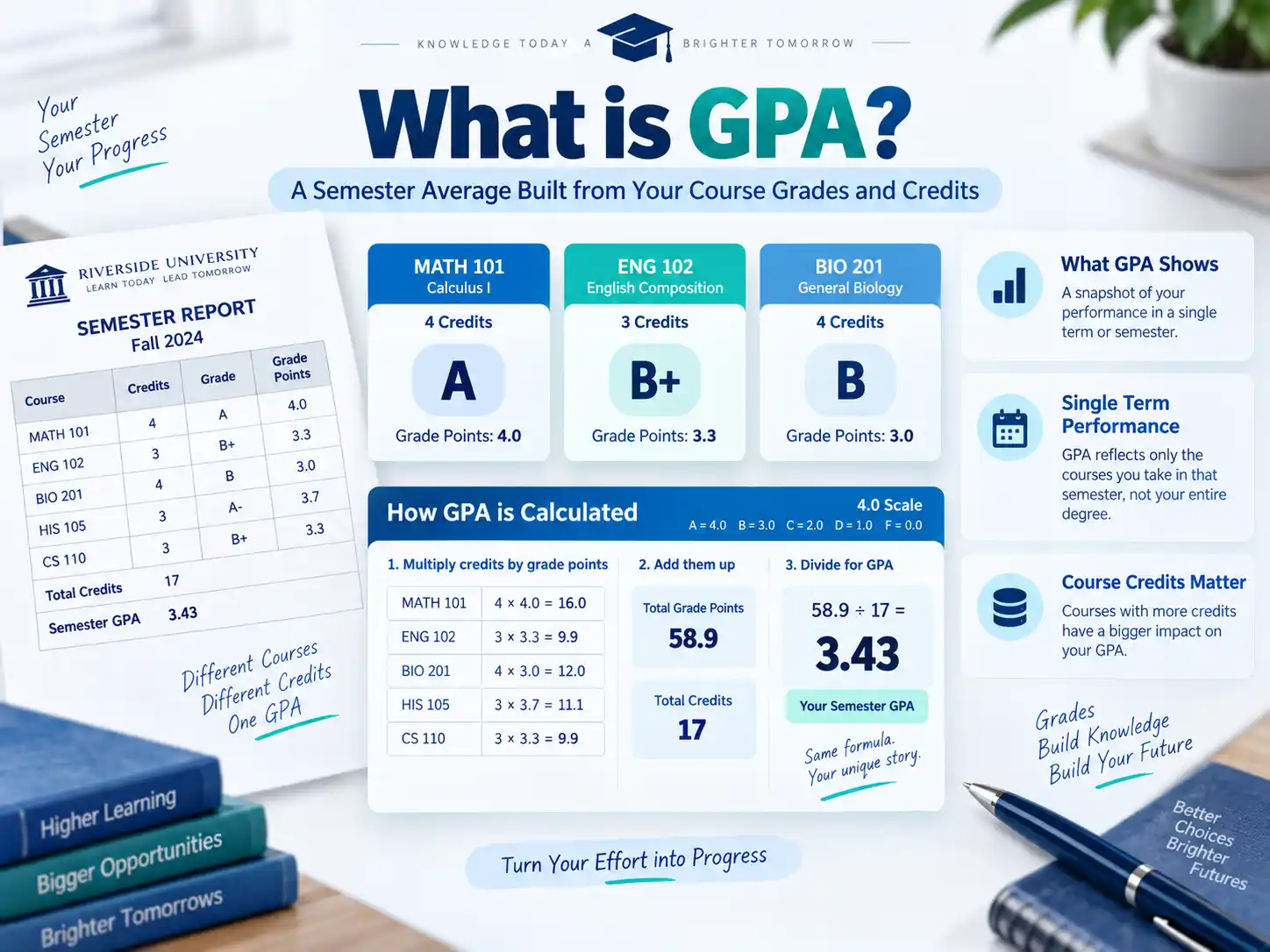
Look at a semester marksheet, and the first thing you normally see is a list of subjects with marks, grades, credits, or some combination of them. Those small entries eventually become the GPA or SGPA shown at the bottom. Two subjects sitting next to each other on the same page can still affect that final number differently if one carries more credits.
Suppose one course carries four credits while another carries only two. If the university takes those credits into account, the four-credit subject has more influence on the semester result. Simply adding both grade points and dividing them equally may give you a neat answer, but it may not be the answer your university uses.
The calculation can get slightly annoying once several credits and decimal values are involved. You may end up dividing one total by another and dealing with a fraction before the final number looks familiar. A fraction calculator is handy at that point because it can deal with the arithmetic while you concentrate on whether the correct grades and credits have actually gone into it.
That distinction matters more than it first appears. A calculator can solve 43 ÷ 6 perfectly, but it cannot tell you that you accidentally entered three credits for a subject that actually carries four. The maths can be completely correct and the academic result can still be wrong.
GPA Is Easier to Understand When You Ignore the Final Number for a Moment
GPA stands for Grade Point Average. Instead of keeping every course as a mark out of 100, a university gives grades numerical values and uses those values to work out an average. A 4.0 scale is common in the United States, although seeing “4.0 scale” does not tell you every detail about how that college calculates the result.
Imagine a semester where you receive an A in one course and a B in another. Looking only at the letters, it is tempting to think that both subjects should contribute equally. If the A belongs to a one credit subject and the B belongs to a four credit subject, the final GPA can lean much more toward the grade earned in the larger course.
The grading table can change things as well. One institution may assign a separate numerical value to an A minus grade, while another may group it differently. For that reason, taking grades from one university and putting them into a random GPA formula can produce a number that looks perfectly sensible but does not match the official record.
Once several subjects are involved, doing all of this repeatedly by hand becomes more irritating than useful. A GPA calculator can make the calculation quicker because you can enter each course with its own credit value and see the average immediately. It still depends on the information you provide, so the grading scale shown by your university should come first rather than letting the calculator decide it for you.
CGPA Is Where Several Semesters Start Meeting Each Other
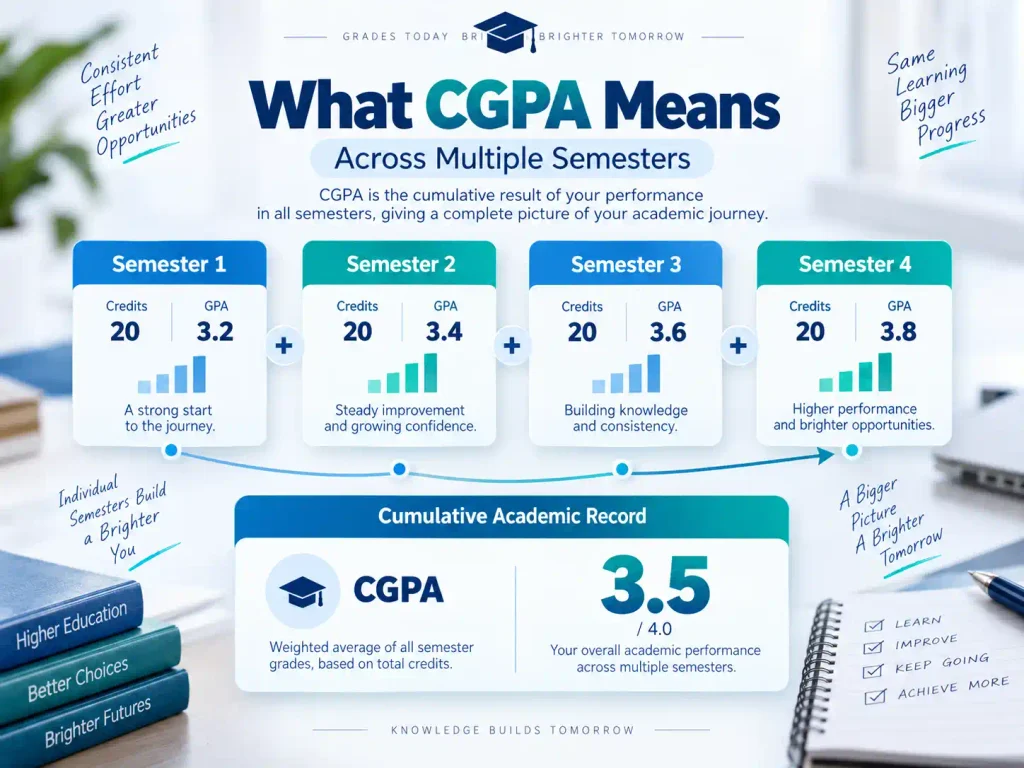
CGPA stands for Cumulative Grade Point Average. The important part is not really the longer name, but the fact that the number usually represents a wider period of study. Instead of telling you how one semester went, it brings results from several semesters into one cumulative score.
Many Indian university marksheets make this easier to see because SGPA and CGPA can appear separately. The SGPA belongs to a particular semester, while the CGPA changes as more semester results are added. By the final year, that one CGPA may be carrying information from a large number of courses completed over several terms.
A common mistake happens when someone sees two SGPA values and immediately takes their simple average. That works only when the university treats both semesters with equal weight. If the first semester contains 18 credits and the next contains 26, the second semester may contribute more to the cumulative result.
This explains why a CGPA calculated at home can sometimes be a little different from the number printed by the university. It is easy to assume that rounding caused the difference, when the real reason may be that the official calculation included the total credits completed in each semester.
The Meaning of GPA and CGPA Is Not Identical Everywhere
The terminology itself creates some of the confusion. In one college, GPA might mean the result for a semester. Somewhere else, the same term can be used for the cumulative score across the complete course.
CGPA is commonly used for the cumulative result in many Indian institutions, but that does not turn it into a worldwide rule. Universities choose their own grading terminology, and the academic regulations behind the marksheet tell you more than the abbreviation by itself.
You can see the problem when an international application asks you to enter your GPA. Your transcript may contain CGPA instead, and the natural reaction is to convert it straight away. The application may actually want your original score with the scale beside it, because the admissions team plans to compare different grading systems itself.
That small detail can save a lot of unnecessary calculation. If a form accepts the result exactly as your university issued it, creating another number only introduces another place where something can go wrong.
Percentage Is Familiar, but Converting Into It Is Not Always Simple
A percentage usually feels easier because everybody understands what 78 percent means. The scale is visible immediately. With a CGPA of 8.1, you still need to know whether the university uses a 10 point scale and how it relates that scale to percentage.
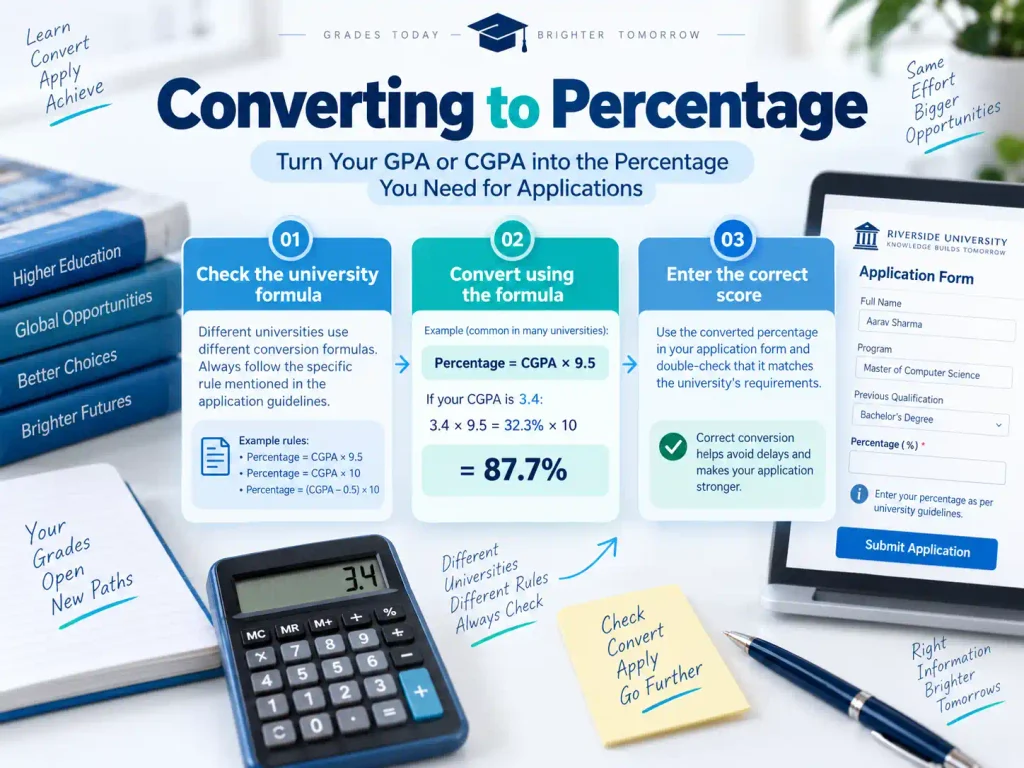
This is where the famous multiplier formulas start appearing. Search for “CGPA to percentage,” and you will quickly find pages telling you to multiply by 9.5, while another page may show a different formula. The confusing part is that both pages can be correct for the academic systems they are talking about.
There is no one multiplier that every university is required to use. Some institutions publish their own formula, while others provide a table showing which percentage range corresponds to each grade point. A few universities already print an equivalent percentage on the transcript, which means there is no reason to create another value yourself.
The difference becomes important when the number is going onto something official. A rough percentage is perfectly useful when you only want to understand where your CGPA sits, but a scholarship form may later compare what you entered with a university document. If the two numbers came from different formulas, you can end up explaining a mismatch that did not need to exist.
What Usually Happens on an Application Form
Consider a fairly common situation. You open an admission portal and reach the education section, where a menu asks for the grading system. The options may include percentage, GPA, and CGPA, followed by another field where you enter the actual score.
If CGPA is available and your marksheet says 8.4 CGPA, the sensible choice is normally to enter that original value. Converting it into a percentage first adds nothing useful because the portal has already given you a place for the grading system you studied under. More importantly, the number on the screen now matches the document you may have to upload later.
A different form may offer only a percentage. In that case, the next thing worth checking is whether the page gives any instructions about conversion. Some universities tell applicants to use the formula of their own institution, while others ask for a conversion certificate or perform the conversion after receiving the transcript.
It is easy to overlook those instructions because the percentage box is sitting right there waiting for a number. Taking a minute to read the note beside it is usually safer than filling the box with the first online conversion you find, because the receiving institution may have a specific method in mind.
A Realistic Example Shows Where the Numbers Can Change
Suppose your first semester SGPA is 8.2 and the next semester result is 8.6. If both semesters contain the same total number of credits, taking their simple average gives:
(8.2 + 8.6) ÷ 2 = 8.4
Nothing complicated is happening there. Both semesters have been treated equally, so 8.4 is the expected average for this example.
Now change one detail. Imagine the first semester carries 20 credits and the second carries 28. The two SGPA values still look like ordinary numbers on the marksheet, but treating them as equal may no longer reproduce the university CGPA because more academic credit was completed during the second semester.
That is the kind of detail people often miss when they jump directly to percentages. The conversion formula may be entered perfectly, but it is being applied to a cumulative score that was calculated incorrectly before the percentage calculation even began.
For another example, suppose the university itself states that its percentage conversion is CGPA × 9.5. If the official CGPA is 8.4, the equivalent under that university rule would be:
8.4 × 9.5 = 79.8%
The important words there are “under that university rule.” Taking the same 8.4 from another institution and multiplying it by 9.5 simply because the formula appeared in a search result does not make 79.8 percent an official conversion for that student.
Why Two Online Converters Can Give Different Answers
People sometimes assume that one of two different answers must be wrong. Quite often, the calculators are simply following different conversion rules. One may have been built around a particular university formula, while another is using a more general estimate.
The difference is easier to understand if you think about the input rather than the final number. A calculator only knows the CGPA and whatever formula has been programmed into it. It does not see your transcript or automatically know the academic policy of the university that issued it.
This is also why an online converter should not quietly become the authority for an official application. It is useful for calculation once the correct method is known, but the source of that method should still be the university or the organisation asking for the converted score.
You do not need to distrust every calculator because of this. You simply need to separate the maths from the grading rule, since the calculator is good at the first part but cannot invent the second part for your institution.
Sometimes the Best Conversion Is No Conversion
Students often feel that percentage looks more official because it is familiar. That can lead to unnecessary conversions even when the original CGPA is already accepted.
Suppose an employer asks you to enter your highest qualification and provides a field labelled “CGPA or percentage.” If your university transcript contains CGPA, entering that value directly keeps your application consistent with the document. Creating a percentage just because it looks easier to read gives the employer a number your university may never have issued.
The same thing can happen during university admissions. Some overseas institutions specifically prefer the original academic record because they have their own system for comparing grades from different countries. Converting your score first can actually remove information they wanted to see.
Whenever the original grading system is accepted, leaving the result in that form avoids an unnecessary extra calculation. The reason is practical rather than theoretical: the value on the form will be the same value the reviewer later sees on the transcript.
Small Mistakes Usually Begin Before the Percentage Appears
A final percentage can be wrong even when the last multiplication was done correctly. The mistake may have happened earlier because one subject was given the wrong credit value or because two semesters were averaged equally when the university did not treat them equally.
These errors are annoying because the final result often looks believable. A wrong answer of 79.2 percent does not immediately look suspicious when the correct answer was 78.6. Unless you compare the calculation with the original academic record, the difference can easily pass unnoticed.
The problem grows when the same number is reused. You might enter it on one scholarship form, copy it into a job application later, and then use it again somewhere else. What began as one incorrect credit value has now become the academic score you are repeatedly reporting.
Going back to the marksheet before an important submission prevents that situation because it gives you a fixed reference. The grades and credits on that document tell you what went into the original score, while the university conversion rule tells you what should happen to it afterwards.
There Is No Need to Memorise Every Formula
GPA and CGPA often feel harder than they really are because people try to remember formulas before understanding what the numbers represent. Once you know which grades are being counted and how the credits affect them, the calculation becomes much easier to follow.
Percentage conversion works in much the same way. You do not need a universal formula in your head because no universal formula covers every institution. What you need is the correct rule for the academic record sitting in front of you.
That approach also makes unusual cases easier to handle. If your university uses a different scale or gives an official conversion table, you are not trying to force the result into a formula learned somewhere else. You simply follow the system that produced the score.
The Bottom Line
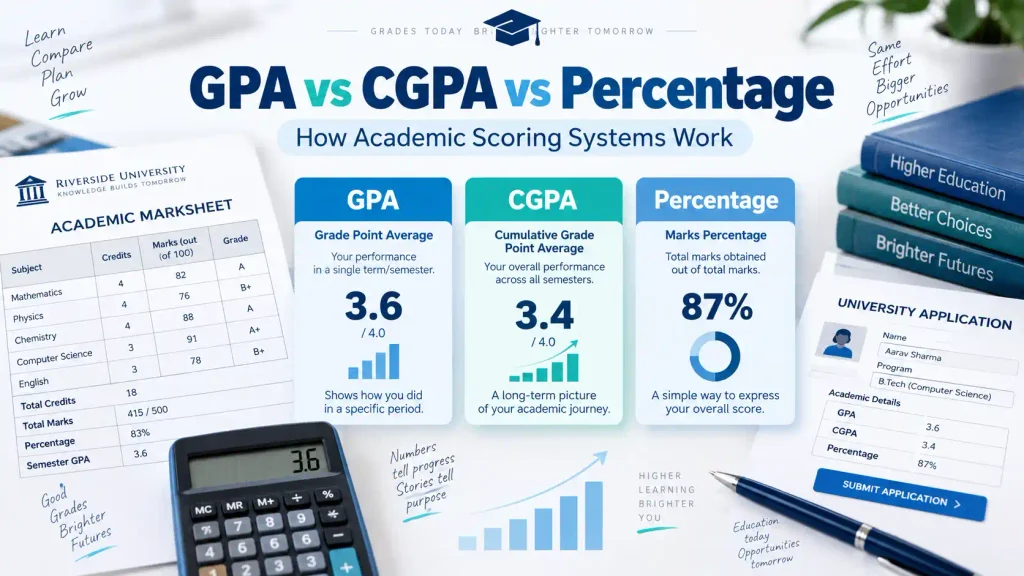
GPA and CGPA are both ways of bringing several academic results into one number, while percentage shows performance on a scale of 100. They are connected, but moving from one to another only works properly when the grading scale and course credits behind the original score are understood.
The practical part is simpler than it first looks. Start with the marksheet you actually received, see how your institution calculated the result, and look at what the next form is really asking for. If a conversion is required, use the rule that belongs to that academic system rather than a familiar multiplier copied from somewhere else.
Once those pieces are clear, the maths stops being the confusing part. You know what number you are starting with, why it needs to change, and whether the result you are about to submit can actually be supported by your academic record.