A low grade from an earlier term stays in your GPA, and the option to take that class again starts to look like a direct fix, but the actual outcome depends on how the college treats both attempts inside the calculation, rather than on the effort alone.
The idea sounds simple at first, because improving a grade should logically improve the average, yet GPA does not work on logic alone and instead follows a fixed calculation method that depends on grade points and credit hours.
Most confusion begins when the second grade is assumed to replace the first by default, while many colleges keep both attempts on the transcript and then apply a rule that decides how much each attempt actually counts. This difference between expectation and calculation is where students start feeling that something is not adding up, even after putting in more effort.

Direct Answer
A second attempt can raise GPA, but the size of the change depends on the repeat policy used by the college, because some systems replace the earlier grade, some combine both grades, and some count every attempt in full. The same improvement in marks can therefore produce a very different outcome depending on which rule is applied to the transcript.
This is the first thing to understand before making any decision, because the grade alone does not control the result. The rule applied to that grade decides how much it actually changes the final number.
| Policy Type | What Happens to Old Grade | GPA Impact |
|---|---|---|
| Replacement | Removed from GPA | Strong |
| Averaging | Combined with the new grade | Moderate |
| Both Count | Fully included | Limited |
What a Repeated Course Actually Means
When the same subject is taken again, the new result is recorded as another attempt, while the earlier result usually remains on the transcript, which means the academic record shows both attempts even if the GPA is adjusted later. This is important because the transcript is designed to show the full academic history rather than only the latest result.
The key point here is not just the second grade but how the earlier one is handled after the new result is posted. In many cases, both attempts remain visible, and the difference comes only in how the GPA calculation uses those attempts behind the scenes.
Why a Better Grade Does Not Always Fix the GPA
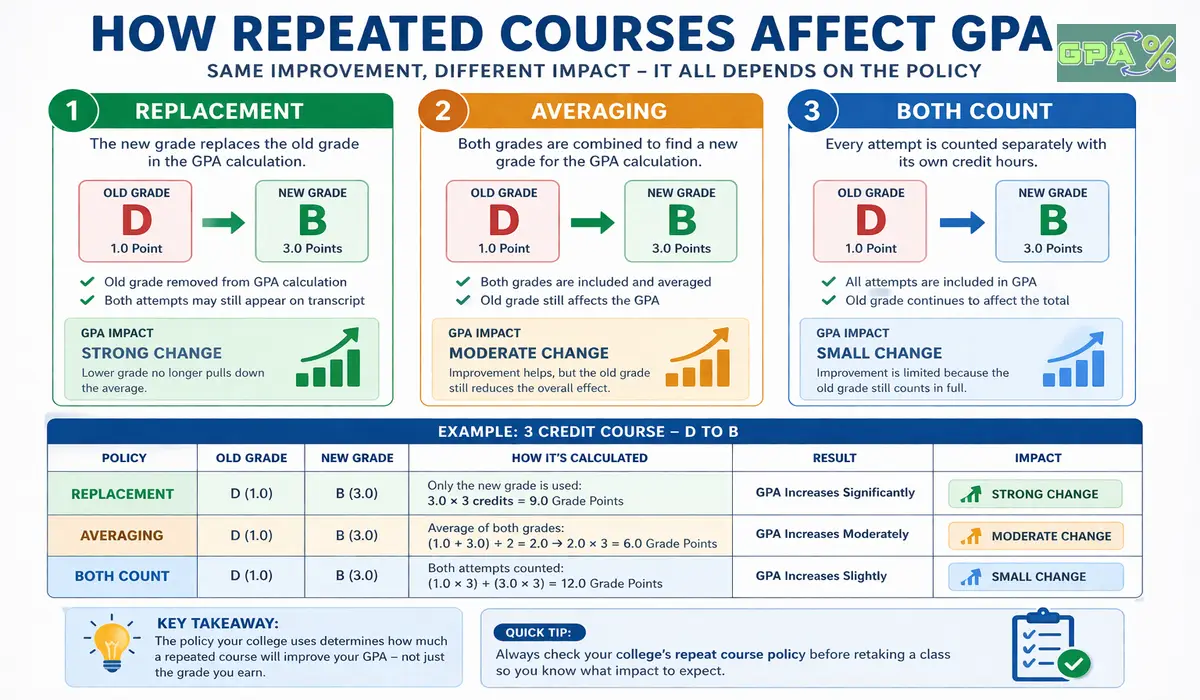
A stronger 2nd result does not always move the average as expected because GPA is built from grade points multiplied by credit hours across all attempts, so unless the earlier grade is removed from that calculation, it continues to affect the total. This means the earlier grade can still reduce the impact of the improvement.
This is why improvement can feel real but look smaller in the final number, especially when both attempts are counted or combined. The calculation does not ignore earlier performance unless the policy specifically allows it.
The Three Main Policies That Control the Outcome
Different colleges follow different rules when a course is taken again, and these rules decide how the earlier and later grades are used in GPA calculation. This is the main factor that creates variation in results, even when the same improvement is achieved.
It is good to understand these policies before repeating a course because it helps avoid incorrect expectations, and the same effort can produce different outcomes depending on how the system is structured. A formal repeat-course policy shows exactly which rule a school uses.
Grade Replacement
The newer grade is used in GPA, and the earlier grade stops affecting the average, although both attempts can still appear on the transcript. This creates the strongest impact because the lower grade is no longer pulling the average down.
When a low grade is replaced with a higher one, the GPA reflects only the improved performance, which is why this policy produces the most visible change among all options.
Grade Averaging
Both grades are included and combined, so the earlier result still contributes to the average alongside the new one. This reduces the overall impact because the lower grade is still part of the calculation.
The improvement still helps, but it does not show fully because the earlier attempt continues to balance the higher result.
Both Attempts Count
Every attempt is counted in full with its own credit hours, so the earlier grade continues to affect the GPA even after a better result. This is the least impactful scenario in terms of visible GPA change.
The newer grade improves the total, but the earlier grade keeps reducing the effect, which makes the overall change smaller.
A Simple Example That Shows Why Policy Matters
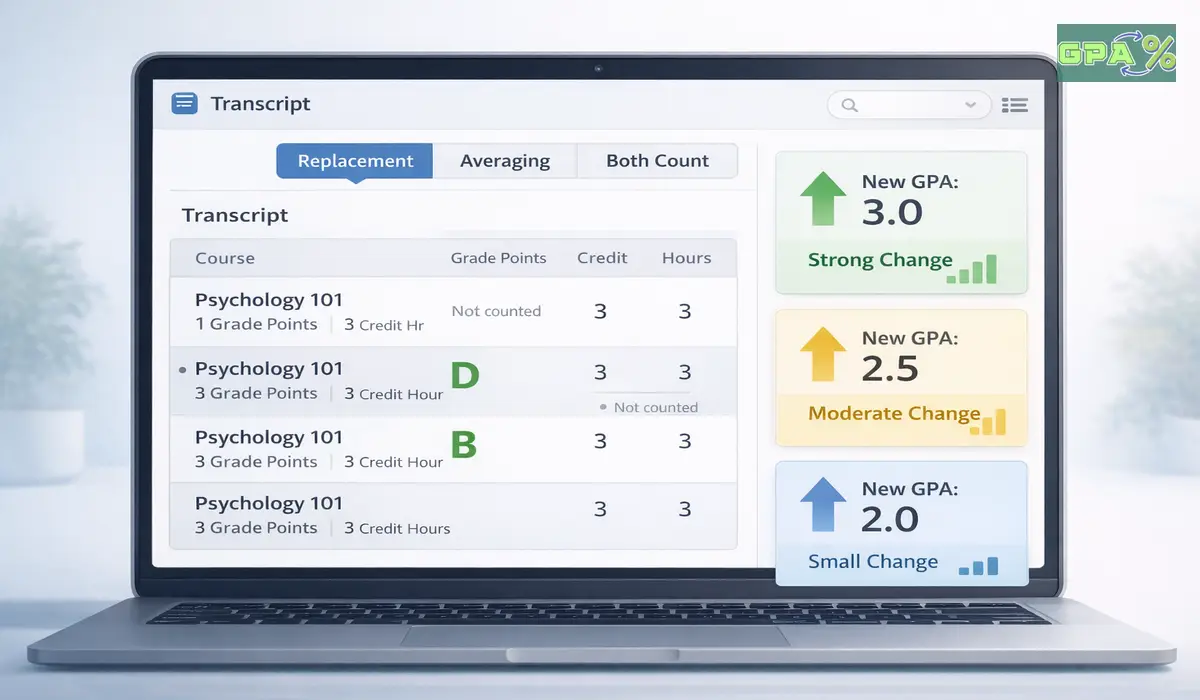
A 3 credit class moves from a D to a B, and the outcome changes only because the rule changes, not because the work is different. The same improvement produces a different result depending on how the grades are handled.
Under replacement, only the B is used, which creates a stronger increase. Under averaging, both grades are combined, which creates a moderate increase. When both attempts are counted, the earlier D continues to affect the GPA, which limits the overall improvement.
When a Retake Helps the Most
A 2nd attempt helps most when the earlier grade is low, the new grade is clearly higher, and the course carries enough credit hours to influence the total. A large difference between grades creates a stronger shift in grade points.
The change shows up more clearly when the subject carries higher credit hours, because each grade has a larger share in the total that is used to calculate the GPA.
When the Change Stays Small
The change is small when the improvement is limited, when both attempts are included, or when many credits are already completed, because each new grade contributes less to a large cumulative total. This reduces the visible impact of improvement.
In such cases, the effort still improves understanding, but the GPA does not reflect that improvement strongly.
Why Students Misread the Outcome
The new grade creates an expectation of a strong jump, but the transcript follows policy, which is why the visible change does not always match the effort. The system works on rules, not assumptions.
- Expectation based on the new grade only, policy not checked before the decision, and the earlier grade assumed to be removed
Repeating a Failed Course vs a Passed Course
The impact changes depending on where the starting point sits, because a shift from a failing grade to a passing grade creates a larger difference in grade points, while improving an already passing grade creates a smaller change in the overall average. The earlier result carries a lower value in the first case, so replacing or balancing it changes the total more clearly.
A failed course holds very low or zero grade points, so improving it removes or balances a weak value in the calculation, depending on policy, which is why the change feels stronger compared to improving a grade that already had a reasonable value in the GPA.
How Colleges Read Multiple Attempts
Colleges do not remove earlier attempts from the transcript because the academic record is meant to show the full path across semesters rather than only the final outcome, so both results remain visible even when GPA is adjusted.
Admissions teams look at patterns over time, which means improvement after a weak start is noticed, but the earlier grade still remains part of the record and continues to provide context for the overall performance. NACAC also notes that the official transcript remains central to how academic history is reviewed.
When Taking the Course Again Is Worth It
The decision makes sense when the earlier grade clearly pulls the GPA down, and there is a realistic chance of achieving a much higher result in the next attempt, because the gap between the two grades creates the actual change in the final average.
It also depends on how the college applies its rule, since replacement creates a stronger shift while other systems reduce the visible effect, so checking the policy first gives a clearer expectation before making the decision.
When It May Not Be Worth It
If the earlier grade already sits at a moderate level and the expected improvement is small, the change in GPA may not justify the effort, especially when many credits are already part of the cumulative record.
In such cases, you can focus on upcoming courses with higher credit value to create a better shift in GPA instead of trying to adjust an older result.
Estimating the GPA Change Before Deciding
Before enrolling again, it helps to compare how the GPA would look under different policies, because the same improvement produces different results depending on whether the earlier grade is removed, combined, or counted together.
You can look at these scenarios in advance to get a clearer idea of how much the final number will move, and you can reduce the chance of making a decision based on an assumption.
| Scenario | Policy Type | Expected GPA Movement |
|---|---|---|
| Low to High Grade | Replacement | Strong change |
| Low to High Grade | Averaging | Medium change |
| Low to High Grade | Both Count | Small change |
Key Takeaway
The effect of a second attempt depends on how the new grade is placed into the calculation alongside the earlier one, which is why the same improvement can create different results across colleges.
- Policy decides impact more than effort alone
- A large grade gap creates greater change
- An earlier grade may still remain in calculation
FAQs
Does repeating a failed course increase GPA more?
A failed course usually leads to a stronger GPA improvement after a second attempt because the difference between the earlier and later grades is larger, which means the increase in grade points has a bigger effect on the total calculation.
Do colleges ignore the first attempt?
Colleges do not ignore the first attempt completely, since it stays on the transcript as part of the academic record, even when GPA is adjusted through replacement or other policies.
Is repeating a B or C grade useful?
A second attempt for a B or C grade leads to a smaller GPA change unless the improvement is significant, because the earlier grade already contributes a moderate value to the overall average.
Can repeating hurt GPA?
A second attempt can reduce GPA when the new grade does not improve enough or when both attempts are counted together, since the earlier grade continues to affect the total calculation.