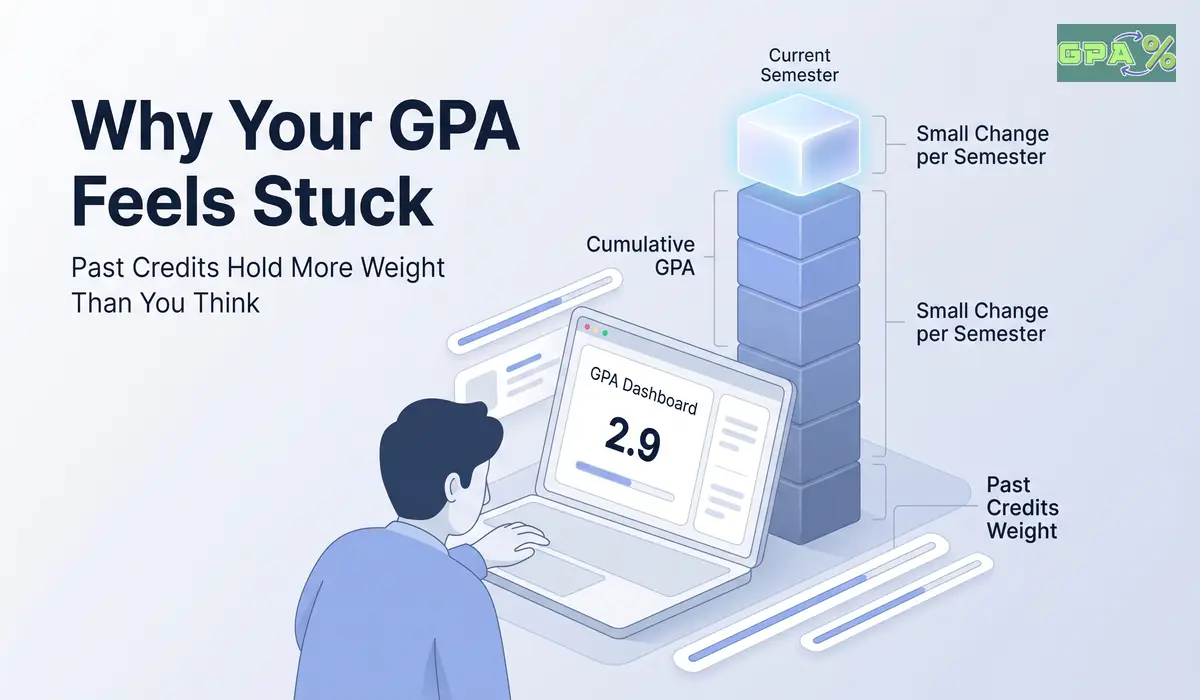
A GPA that stays lower than expected creates a clear problem, because the number is visible on the transcript, while the path to change it is not always obvious. Many students try to push grades up in one term and expect a sharp jump, then feel stuck when the number barely moves.
The gap usually comes from not knowing how GPA responds to grades, credit hours, and time. Once these parts are clear, the process follows a plan that can be checked and adjusted instead of guessing.
First Reality You Need to Accept
GPA does not jump in one step when several semesters are already part of the record. A strong term improves the number, but the size of that change depends on the total credits completed so far.
Semester GPA reacts quickly because it covers one term. Cumulative GPA reacts slowly because it combines all past work. This difference explains why progress can look small even after better grades.
What Actually Affects Your GPA
GPA moves through three parts working together.
- grade points for each course
- credit hours for each course
- total credit hours already completed
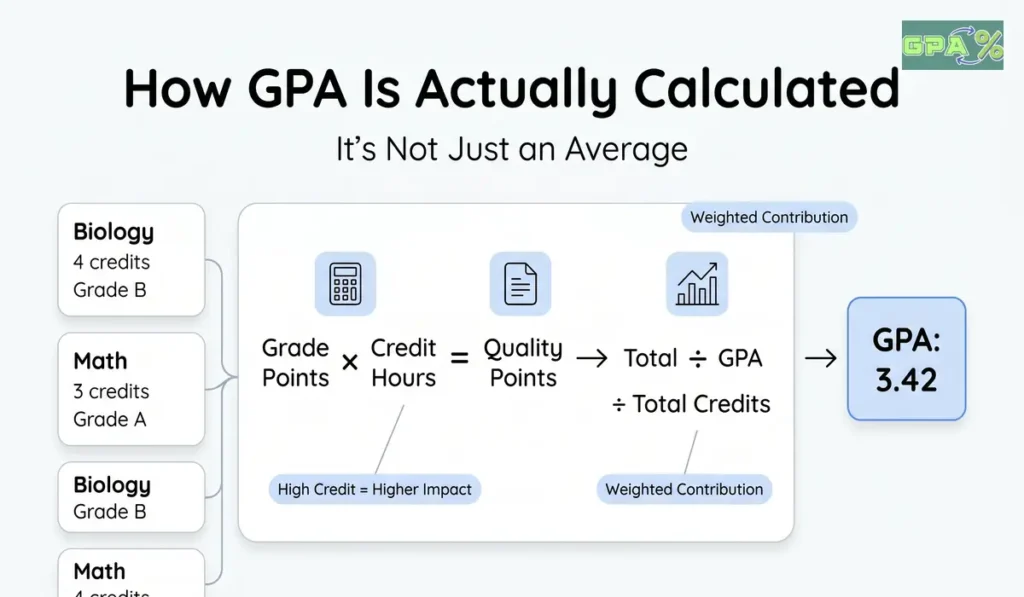
Each course contributes quality points, which come from grade points multiplied by credit hours. The final number is the total quality points divided by total credits. Because of this, a higher grade in a higher credit course shifts the GPA more than the same grade in a smaller course.
Where the Biggest Change Comes From
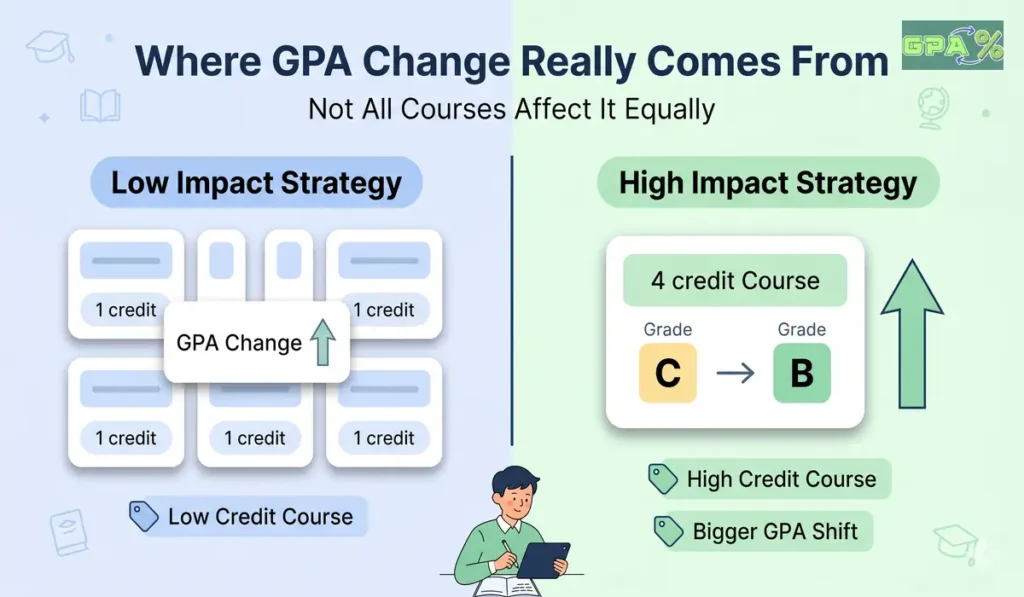
Not all effort creates the same result, because GPA calculation depends on how each course contributes through its credit hours and grade points, which means that time and effort placed on one subject may shift the final number much more than the same effort placed on another subject with a lower weight.
Courses with higher credit hours and lower grades create the largest opportunity for change. Improving a 4 credit course from a C to a B moves the GPA more than improving a 1 credit course by the same grade step. Work placed on these courses shows up clearly in the final number.
The second driver is repeated performance. One strong grade helps, while a full term of strong grades creates a steadier increase that carries forward into the cumulative GPA.
Course Selection Strategy
Course load affects how GPA changes because each course carries its own credit weight, and those weights decide how much each grade shifts the final number rather than simply adding to the workload.
A balanced mix works better than stacking only difficult classes or only lighter ones. Too many heavy courses at once can pull grades down, while only lighter courses may not create enough academic progress.
In high school, weighted GPA systems give extra points for honors or AP classes, but those benefits show only when grades remain high. In college, credit hours carry more influence, so balance across credits becomes the key factor.
Plan Your Next Semester With Numbers
Things start to make sense once you lay out the next term with actual numbers in front of you, because seeing credits, grades, and targets together shows how each course will push the GPA up or keep it where it is.
Start with your current cumulative GPA and total credits. Set a target semester GPA, then estimate the grades required across your courses to reach that target. Adjust the plan before the term ends instead of waiting for results.
| Credits Next Term | Target Semester GPA | Expected Impact |
|---|---|---|
| 12 | 3.5 | small but steady increase |
| 15 | 3.7 | clear upward movement |
| 18 | 3.8 | stronger shift |
Higher credit loads with strong grades create more visible change, as long as the workload stays manageable.
Fix the Subjects That Pull the GPA Down
In most cases, the drop traces back to one or two courses that keep pulling the average down, not every subject at once.
Find the courses where grades are consistently lower and address those first. Improving these courses creates a stronger shift than small improvements spread across all subjects, because their quality points change more.
Timeline of Improvement
When you look at GPA across a few semesters instead of just one term, a clear pattern starts to show up, where each new set of grades adds a small shift and the overall number changes step by step rather than jumping all at once.
- 1 semester creates a small change
- 2 to three semesters create visible movement
- Multiple strong terms reshape the cumulative GPA
Earlier semesters carry more weight because the total number of completed credits is still low at that stage, so each new grade shifts the average more, whereas later changes take longer to show because the growing total credits reduce how much a single semester can move the cumulative GPA.
High School vs College Approach
The way GPA responds to changes is not the same in high school and college, because the grading system and the role of credits work differently in each case, which changes how much impact each decision actually creates over time.
In high school, weighted GPA allows advanced courses such as honors or AP to push the number higher when grades stay strong, and at the same time course rigor becomes part of how the transcript is read during admissions, while in college the impact comes more directly from credit hours, where each course contributes based on its weight and cumulative GPA becomes harder to shift as more semesters are added.
Because of this difference, changes made earlier in the academic timeline tend to show stronger movement, while later efforts still matter but take longer to reflect in the overall GPA.
Common Mistakes That Slow Progress
- Treating GPA like a simple average of grades
- ignoring credit hours when planning effort
- Taking too many difficult courses at once
- waiting for one semester to fix everything
- using incorrect grade values during calculation
Each of these creates unrealistic expectations and slows real progress.
Scenario Guidance
If your GPA is around 2.8, the focus should be on lifting grades in high credit courses and keeping the next two semesters stable, because one term alone will not move the cumulative number much.
If your GPA is around 3.2, improvement can come faster by raising a few key courses and maintaining strong grades across the full term, because the base is already closer to the target range.
If your GPA is above 3.5, the goal shifts from recovery to stability, where consistent grades protect the number, and small gains come from high credit courses.
Use a GPA Calculator to Remove Guesswork
A GPA calculator brings all the pieces together in one place, where your current GPA, total completed credits, and expected grades for the upcoming term can be entered side by side so that the result updates in real time and shows how each course will affect the final number before the semester is even finished, which makes it easier to see what needs to change instead of guessing after the results are out.
How This Connects to Admissions
Admissions teams read GPA along with course rigor and consistency across the transcript. A rising pattern across semesters can strengthen an application even when earlier terms were weaker, because it shows control over later coursework.
This is why steady improvement over multiple terms carries more weight than one isolated result.
Real Calculation Example
A small change in a higher credit course can shift GPA more than expected.
Example for one semester:
| Course | Credits | Old Grade | New Grade | Old Points | New Points |
|---|---|---|---|---|---|
| Biology | 4 | C (2.0) | B (3.0) | 8.0 | 12.0 |
| English | 3 | B (3.0) | B (3.0) | 9.0 | 9.0 |
Total credits = 7
Old total = 17.0
New total = 21.0
Old GPA = 17.0 ÷ 7 = 2.43
New GPA = 21.0 ÷ 7 = 3.00
A single grade change in a 4 credit course moved the GPA much more than keeping the same grade in a 3 credit course.
Before and After Over Multiple Semesters
A realistic change appears over time.
| Term | Semester GPA | Credits | Cumulative GPA |
|---|---|---|---|
| Term 1 | 2.8 | 15 | 2.8 |
| Term 2 | 3.2 | 15 | 3.0 |
| Term 3 | 3.5 | 15 | 3.17 |
| Term 4 | 3.7 | 15 | 3.30 |
The number does not jump in one term because each new set of grades is added on top of the existing credits, so the change appears in small steps across successive semesters as stronger results accumulate and gradually shift the overall average.
Limits of GPA Improvement
There are clear limits to how fast GPA can change, because once a large number of credit hours has already been completed and added into the cumulative calculation, each new semester contributes only a small portion to the overall average, which means even strong grades cannot create an immediate jump and instead shift the number gradually over time.
If many credits are already completed, each new semester carries less weight than before. A jump from 2.5 to 3.5 in one term is not realistic because earlier grades continue to stay in the calculation.
A better expectation is gradual movement across multiple terms, where consistent grades slowly lift the cumulative number.
FAQs
Can GPA increase quickly?
GPA can increase in one semester, but the change is usually small when many credits are already been completed. Larger improvement appears over multiple terms.
Which courses should I improve first?
Courses with higher credit hours and lower grades should be addressed first. These create the largest impact on GPA.
Does one bad semester ruin GPA?
One semester affects GPA, but it does not define the final result. Consistent improvement in later terms can change the overall pattern.
Is it better to take easier courses?
Taking only lighter courses may protect your GPA, but may not strengthen your academic record. A balanced course load works better.
Conclusion
A change in GPA comes from how grade points, credit hours, and time add up across multiple semesters, which means no single term can completely shift the number, but steady changes in the right courses slowly build into a noticeable difference over time as new grades keep getting added to the total record.
When you start looking at GPA this way, with each course carrying a certain weight and each semester adding a small layer on top of what already exists, it becomes easier to see why the number moves the way it does and how consistent performance across terms gradually shifts the overall average instead of leaving it stuck.