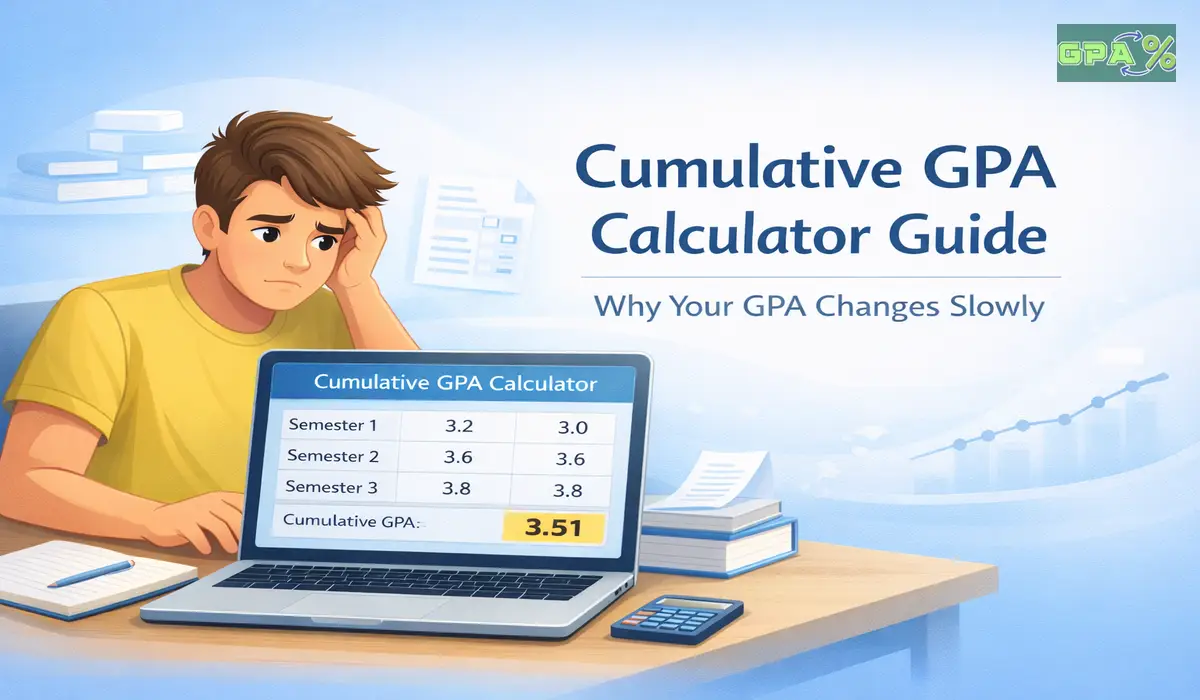
A student completes two or three semesters and expects the GPA to rise quickly after one strong term, but the number barely changes, and that creates confusion.
Many students assume that a good semester should immediately fix earlier performance, yet the cumulative GPA moves slowly because it combines all past academic records instead of focusing on one term.
This situation becomes clearer when you look at how cumulative GPA is calculated. It is not a simple average of semester GPAs, and it depends heavily on credit hours, grade points, and total academic history.
Once you understand this structure, you can read your transcript correctly and use a cumulative GPA calculator to track and plan your academic progress with much better accuracy.
What Is Cumulative GPA
Cumulative GPA is the overall grade point average across all completed semesters or academic terms. It reflects your entire academic record instead of focusing on one specific semester.
This number is important because colleges, scholarship committees, and academic advisors use cumulative GPA to evaluate long-term academic performance rather than short-term results. NACAC also treats the official transcript as a core part of the college application record.
Difference Between Semester GPA and Cumulative GPA
| Factor | Semester GPA | Cumulative GPA |
|---|---|---|
| Scope | One term only | All completed terms |
| Purpose | Recent performance | Overall academic record |
| Change speed | Changes quickly | Changes slowly |
Semester GPA shows how you performed in one term, while cumulative GPA shows how you performed across your full academic journey.
Key Terms You Should Understand
A few important terms explain how cumulative GPA works.
Credit Hours
Credit hours represent the weight of each course. A higher credit course has more influence on GPA than a lower credit course.
Grade Points
Grade points are numeric values assigned to letter grades such as A, B, or C. These values depend on the grading scale used by your school.
Quality Points
Quality points are calculated by multiplying grade points by credit hours. This value is used to calculate GPA across all semesters.
Cumulative GPA Formula
The correct formula for cumulative GPA is:
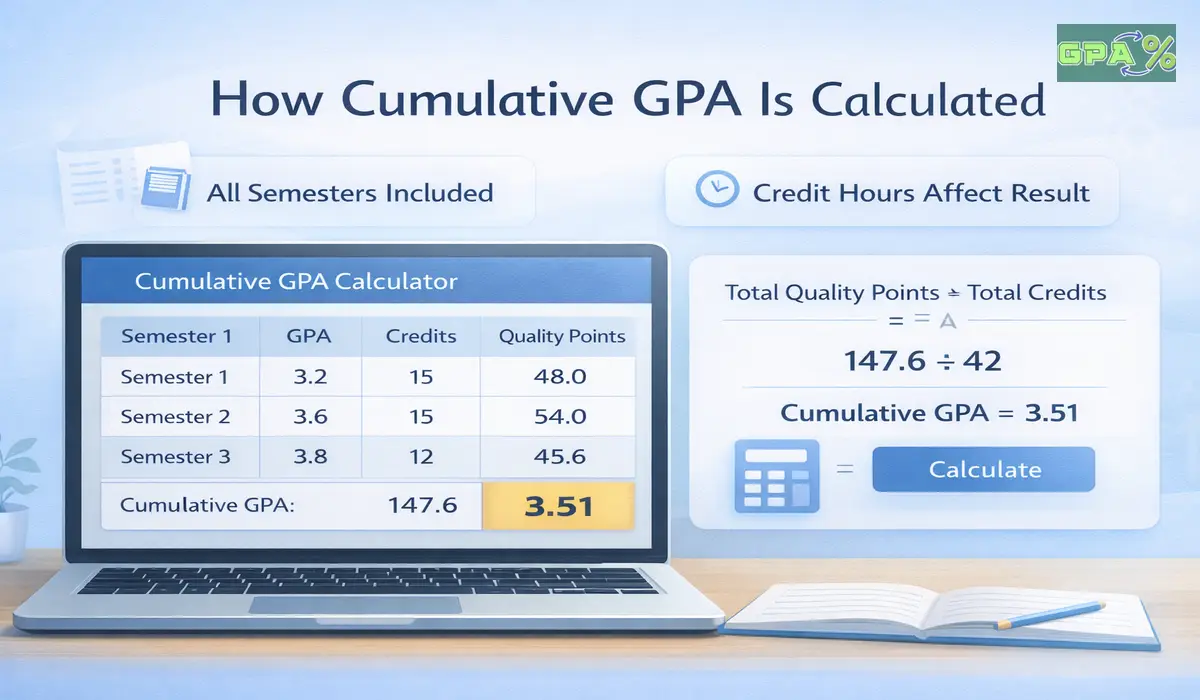
Cumulative GPA = Total Quality Points ÷ Total Credit Hours
This means you combine all grade points from every semester, multiply them by their credit hours, and divide by the total number of credits completed.
Steps for Cumulative GPA Calculation
A clear process makes the calculation easier to follow.
- Collect GPA and credit hours for each semester
- Convert each semester GPA into total quality points
- Add all quality points together
- Add all credit hours together
- Divide total quality points by total credits
This method gives the correct cumulative GPA instead of an estimated value.
Real Multi-Semester Example
| Semester | GPA | Credits | Quality Points |
|---|---|---|---|
| Semester 1 | 3.2 | 15 | 48.0 |
| Semester 2 | 3.6 | 15 | 54.0 |
| Semester 3 | 3.8 | 12 | 45.6 |
Total quality points = 48.0 + 54.0 + 45.6 = 147.6
Total credits = 15 + 15 + 12 = 42
Cumulative GPA = 147.6 ÷ 42 = 3.51
This example shows how each semester contributes to the final GPA according to credit weight.
Why You Cannot Average Semester GPA
Many students try to average semester GPAs directly, but this method produces incorrect results because it ignores credit hours. A semester with more credits has a stronger impact than a semester with fewer credits.
The correct approach always uses quality points and total credit hours instead of averaging GPA values.
How Cumulative GPA Changes Over Time
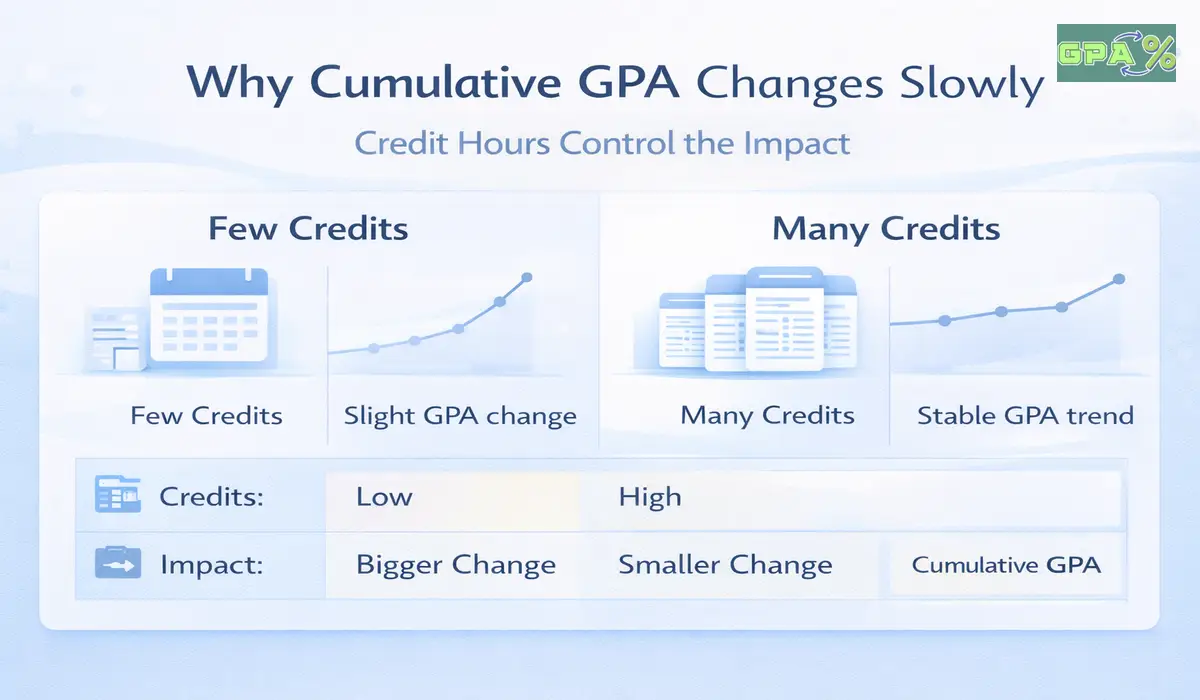
Cumulative GPA changes slowly because it includes all past semesters. Early semesters have a strong influence, and later semesters adjust the GPA gradually instead of creating large changes.
A strong semester improves cumulative GPA, but the improvement depends on how many total credits have already been completed.
How Credit Hours Affect Cumulative GPA
Credit hours determine how much each semester affects the cumulative GPA. A semester with a higher number of credits has a stronger impact compared to a semester with fewer credits.
| Semester | Credits | GPA | Impact |
|---|---|---|---|
| Low Credit Term | 9 | 4.0 | Small change |
| High Credit Term | 18 | 4.0 | Larger change |
This difference explains why students should consider both GPA and credit load when planning academic recovery.
What Courses Are Included in the Cumulative GPA
Most graded courses are included in the cumulative GPA, including failed courses, because they still carry grade points. These courses contribute to total quality points and affect the final GPA.
Some courses may not be included in the same way. Pass or fail courses, withdrawals, and certain non-credit courses may follow different rules depending on the institution.
How Repeated Courses Affect Cumulative GPA
Repeated courses can change cumulative GPA depending on the school policy. Some institutions replace the previous grade, while others include both attempts in GPA calculation.
This difference affects how much GPA can improve after retaking a course, especially when the course carries high credit hours.
Why Students Miscalculate Cumulative GPA
Students often make errors when calculating cumulative GPA because they average semester GPAs directly or ignore credit differences. Small mistakes in grade conversion or rounding can also change the result.
A correct calculation always uses quality points and total credits instead of simple averages.
How a Cumulative GPA Calculator Helps
A cumulative GPA calculator organizes semester data and performs the full calculation automatically. It handles credit hours and grade values without requiring manual computation.
- Provides accurate multi-semester calculation
- Reduces errors in manual math
- Saves time when updating GPA
- Helps track academic progress
How to Use a Cumulative GPA Calculator
Step 1: Enter Current GPA and Credits
Add your existing cumulative GPA and total credits completed.
Step 2: Add Semester Data
Enter GPA and credit hours for each new semester.
Step 3: Calculate
Review the updated cumulative GPA after combining all data.
Step 4: Compare With Goals
Check how close the result is to your target GPA.
Scenario Planning for Future GPA
A cumulative GPA calculator allows you to estimate future performance before grades are finalized.
| Scenario | Credits Next Term | Expected GPA | Result |
|---|---|---|---|
| Moderate | 15 | 3.3 | Small increase |
| Strong | 15 | 3.7 | Noticeable increase |
| Excellent | 15 | 4.0 | Strong improvement |
This approach helps you set realistic academic goals instead of relying on guesswork.
Common Mistakes Students Make
- Averaging semester GPA directly
- Ignoring credit hours
- Using incorrect grade values
- Expecting quick GPA changes
These mistakes create incorrect expectations about academic performance.
What Is a Good Cumulative GPA
A cumulative GPA of around 3.0 is often considered average, while a GPA of around 3.5 is strong in many academic settings. A GPA above 3.7 can be competitive for selective programs and scholarships.
The number should always be considered along with course difficulty and long-term consistency.
How Cumulative GPA Appears on Transcript
A transcript shows cumulative GPA along with semester GPA, course grades, and credit hours. This document represents the official academic record used by institutions.
The registrar defines how GPA is calculated and displayed, which is why the transcript remains the most reliable source for GPA verification. When you need the official calculation rules, checking a registrar GPA policy is more reliable than using estimates.
FAQs
How do I calculate cumulative GPA?
Cumulative GPA is calculated by dividing total quality points by total credit hours. This includes all semesters instead of averaging GPA values.
What is cumulative GPA?
Cumulative GPA is the overall average of all academic performance across semesters. It reflects your full academic record.
Can GPA change after a semester?
Cumulative GPA changes after each semester when new grades are added. The change depends on credit hours and performance.
Why does GPA change slowly?
Cumulative GPA changes slowly because it includes all past semesters. A single semester has a limited impact when total credits are high.
Conclusion
Cumulative GPA represents the complete academic record and reflects performance across all semesters instead of focusing on results from a single term. The calculation depends on credit hours and grade points, which is why the number changes gradually over time.
A cumulative GPA calculator becomes valuable when you understand this structure because it allows you to track progress, estimate future results, and make better academic decisions without guessing or getting misled by wrong calculations.