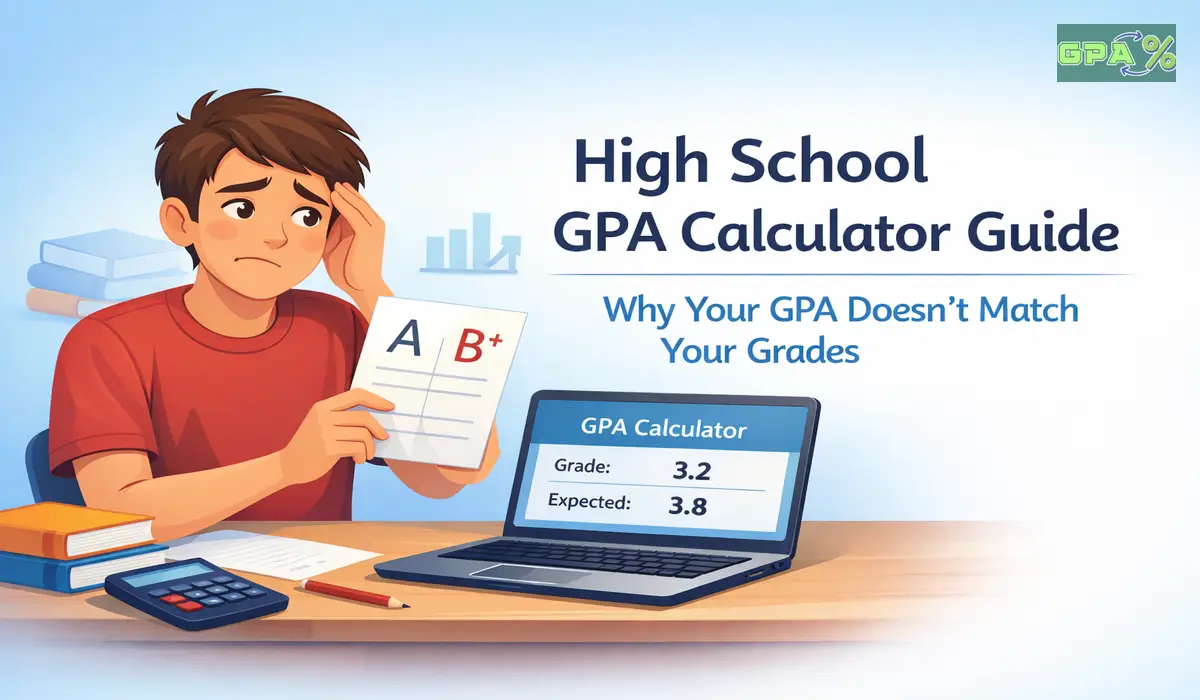
A student sits with a report card after finals and notices something that does not fully make sense. One subject shows an A, another shows a B+, and yet the final GPA does not match what they expected when they tried to average the grades mentally. Then the comparison starts, because another student with similar grades shows a higher GPA, and that creates confusion about how the system actually works.
This confusion usually comes from one place. High school GPA is not calculated in a single fixed way across all schools. Some schools use a standard 4.0 scale, while others add extra value for honors, AP, or IB courses.
Once you understand how these systems work and how GPA is calculated step by step, you can read your grades correctly and use a GPA calculator to plan your performance with much more clarity.
What High School GPA Actually Means
High school GPA is a numeric summary of your academic performance across all graded courses. Schools convert your letter grades into grade points and then calculate an average using either a simple or weighted system.
Two types of GPA usually appear in high school records. Unweighted GPA treats all courses equally, while weighted GPA gives additional value to more difficult courses such as honors, AP, or IB classes.
Unweighted GPA Explained
Unweighted GPA follows a standard 4.0 scale where every course carries equal value regardless of difficulty. This means an A in a regular class and an A in an advanced class both receive the same grade point.
| Grade | GPA Value |
|---|---|
| A | 4.0 |
| B | 3.0 |
| C | 2.0 |
| D | 1.0 |
| F | 0.0 |
This system provides a clear baseline for academic performance but does not reflect course difficulty.
Weighted GPA Explained
Weighted GPA adjusts grade values to reflect course difficulty. Schools assign higher grade points to more advanced courses so that students taking challenging subjects receive recognition in their GPA.
| Course Type | Grade | GPA Value |
|---|---|---|
| Regular | A | 4.0 |
| Honors | A | 4.5 |
| AP / IB | A | 5.0 |
This system allows GPA to go above 4.0 and creates a difference between regular and advanced coursework.
Honors, AP, and IB Course Impact
Honors courses represent a higher level than standard classes, while AP courses and IB courses often follow college level material. Schools assign additional grade points to these courses to reflect their difficulty.
The exact weight depends on school policy, so the same grade in an AP class may carry different value in different schools. This variation is one reason students should always check their school’s grading scale before comparing GPA values.
Key Terms You Should Understand
A few key terms explain how GPA calculation works and remove most of the confusion around the process.
Course Weight
Some schools treat all courses equally, while others assign different weights depending on course difficulty.
Grade Points
Grade points are the numeric values assigned to each letter grade. These values form the base of GPA calculation.
GPA Scale
The GPA scale defines how grades convert into numbers. Most schools use a 4.0 scale, while some extend this system for weighted grading.
High School GPA Formula
The formula for GPA depends on the system used by the school.
Unweighted GPA = Total Grade Points ÷ Total Courses
Weighted GPA = Adjusted Grade Points ÷ Total Courses
In both cases, the final number represents the average of all course grades after conversion into grade points.
Step by Step GPA Calculation
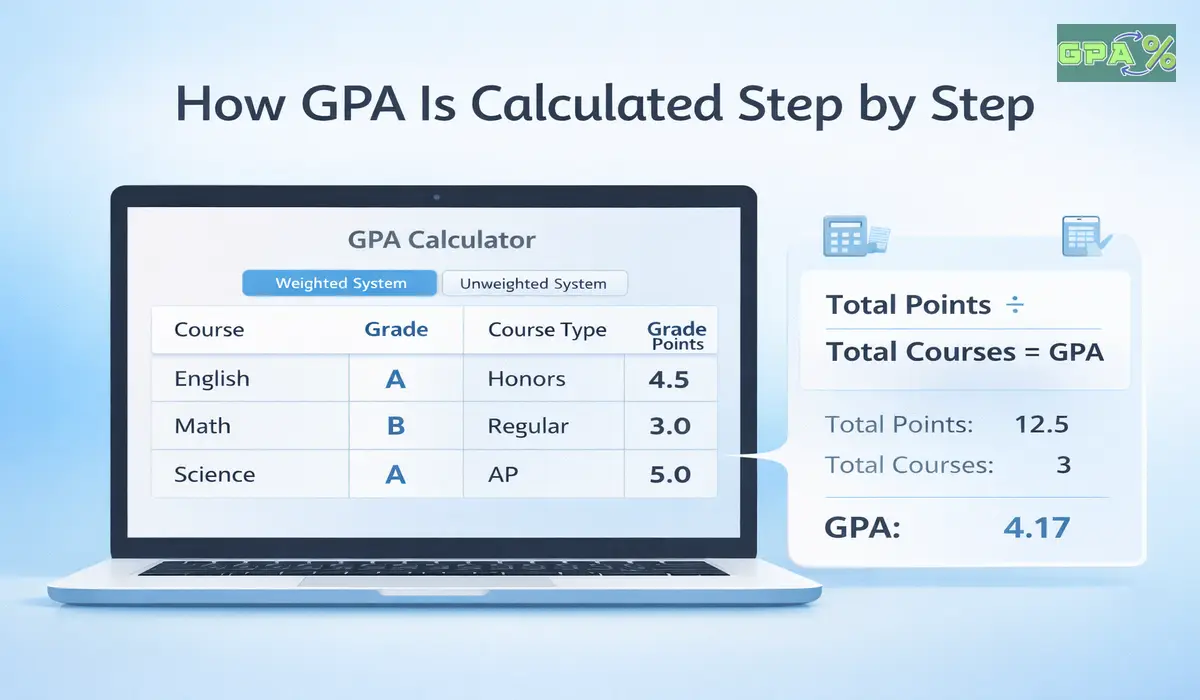
A clear process helps avoid mistakes.
- List all courses
- Assign letter grades
- Convert grades into points
- Add all grade points
- Divide by the total number of courses
This method works for both unweighted and weighted GPAs, with the only difference being the grade point values.
Real Example Unweighted GPA
| Course | Grade | Points |
|---|---|---|
| English | A | 4.0 |
| Math | B | 3.0 |
| Science | A | 4.0 |
| History | B+ | 3.3 |
Total points = 14.3
Total courses = 4
GPA = 14.3 ÷ 4 = 3.57
Real Example Weighted GPA
| Course | Type | Grade | Points |
|---|---|---|---|
| English | Honors | A | 4.5 |
| Math | Regular | B | 3.0 |
| Science | AP | A | 5.0 |
| History | Regular | B+ | 3.3 |
Total points = 15.8
Total courses = 4
GPA = 15.8 ÷ 4 = 3.95
This example shows how advanced courses can increase GPA beyond what an unweighted calculation produces.
Weighted vs Unweighted GPA Comparison
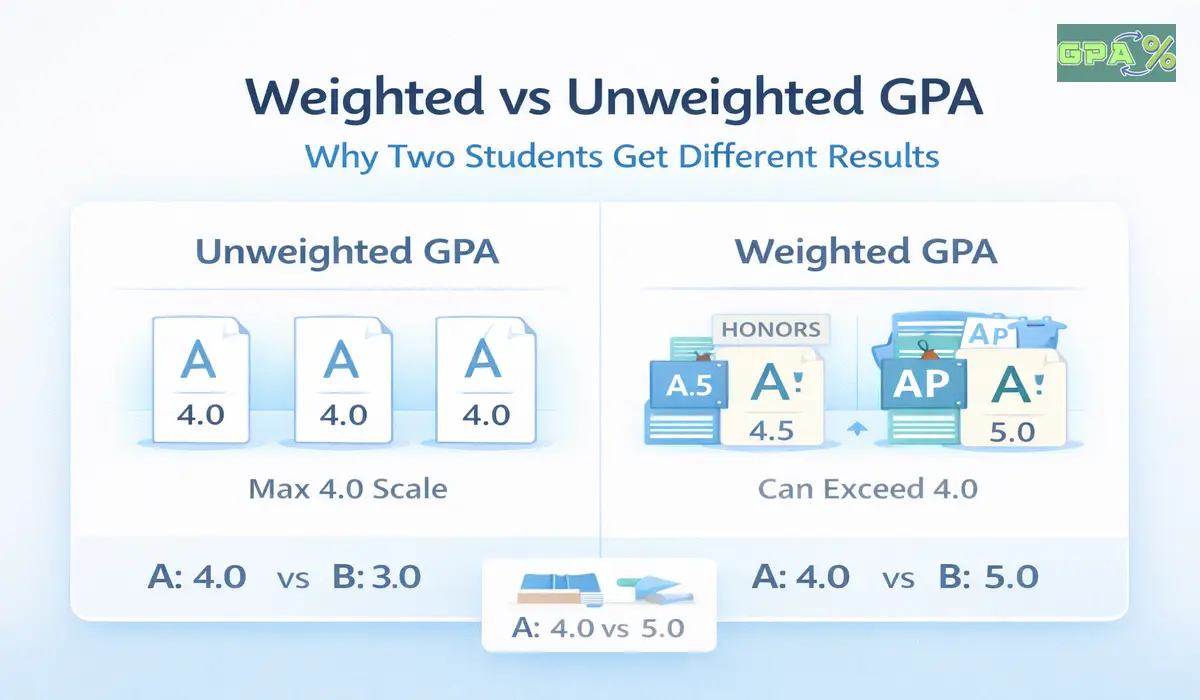
| Factor | Unweighted GPA | Weighted GPA |
|---|---|---|
| Scale | Up to 4.0 | Can exceed 4.0 |
| Course difficulty | Not considered | Considered |
| GPA impact | Equal for all classes | Higher for advanced classes |
This comparison shows why two students with similar grades can have different GPA values.
Semester GPA vs Cumulative GPA
| GPA Type | Meaning |
|---|---|
| Semester GPA | Performance in one term |
| Cumulative GPA | Performance across all terms |
Semester GPA shows short term performance, while cumulative GPA reflects long term academic consistency.
How GPA Appears on High School Transcript
A high school transcript lists courses, grades, GPA values, and sometimes both weighted and unweighted GPAs. This document is important for college applications because it provides a detailed academic history.
School counselors and registrars define how GPA is displayed and calculated, which is why transcript format can vary between schools.
How Colleges View High School GPA
Colleges do not rely on GPA alone. They review course difficulty, grading scale, and consistency of performance across years.
A student with strong grades in advanced courses may stand out more than a student with similar grades in less challenging classes. This is why weighted GPA and course selection both matter in admissions. For students planning to compete in Division I sports, the NCAA also outlines core-course GPA expectations in its initial-eligibility toolkit.
Why Manual GPA Calculation Creates Confusion
Manual calculation is difficult when grading scales differ or when weighted systems are involved. Small errors in grade conversion or course weighting can change the final GPA.
A GPA calculator removes these issues by handling grade conversion and averaging in one place.
How the High School GPA Calculator Helps
A GPA calculator allows you to enter grades and course levels and receive an accurate GPA without repeating the calculation manually.
- Reduces calculation mistakes
- Handles weighted and unweighted systems
- Saves time when checking multiple scenarios
- Helps plan future academic performance
How to Use the High School GPA Calculator
Step 1: Enter Courses
List all subjects from your schedule.
Step 2: Select Course Type
Choose regular, honors, or AP depending on the course.
Step 3: Enter Grades
Select the correct letter grade for each course.
Step 4: Calculate GPA
Review the result and compare it with your expected outcome.
Scenario Planning for Future GPA
A GPA calculator can also help you estimate future performance.
| Scenario | Expected Grades | Estimated GPA |
|---|---|---|
| Moderate | Mix of A and B | Stable GPA |
| Strong | Mostly A grades | Noticeable increase |
| Excellent | All A grades | Maximum improvement |
This approach helps you understand what level of performance is needed to reach a target GPA.
Common Mistakes Students Make
- Ignoring weighted GPA differences
- Comparing GPA across different scales
- Using incorrect grade conversions
- Focusing only on GPA instead of course difficulty
These mistakes can create incorrect assumptions about academic performance.
What Is a Good High School GPA
A GPA around 3.0 is usually considered average, while a GPA around 3.5 is seen as strong. A GPA above 4.0 in a weighted system can be competitive for selective colleges.
The number should be considered along with course difficulty and academic progress over time.
FAQ
How do I calculate a high school GPA?
High school GPA is calculated by converting grades into points and averaging them. The exact method depends on whether the school uses weighted or unweighted GPA.
What is a weighted GPA?
Weighted GPA gives extra points for advanced courses such as honors or AP. This allows GPA to go above 4.0 in some schools.
What is an unweighted GPA?
Unweighted GPA treats all courses equally using a standard 4.0 scale. It does not account for course difficulty.
Does GPA matter for college?
GPA plays a major role in college admissions decisions. Colleges also review course difficulty and academic consistency.
Can GPA go above 4.0?
GPA can exceed 4.0 in weighted systems where advanced courses carry extra value. This depends on the grading system used by the school.
Conclusion
High school GPA is not just a number but a proper representation of academic performance that depends on the grading scale, course difficulty, and calculation method. Once you understand how weighted and unweighted systems work, you can interpret your transcript correctly and avoid confusion when comparing results.
A high school GPA calculator is a useful tool when paired with that understanding, as it allows you to check your current performance and plan future outcomes with accuracy. This combination gives you better control over academic decisions and prepares you more effectively for college admissions.