You open your transcript and notice a GPA like 4.12 or 4.20, and the number does not match what you expected because you already know that GPA is usually measured out of 4.0. This situation creates confusion because the grading system appears inconsistent, even though the calculation follows a clear structure.
This happens when a school uses a 4.33 GPA scale, where an A+ grade carries more value than a standard A and allows the final GPA to go slightly above 4.0. Once you understand how this scale works, the numbers on your transcript become easier to interpret, and you can read your academic performance with clarity.
What Is the 4.33 GPA Scale
The 4.33 GPA scale is an extended version of the standard 4.0 grading system, where letter grades are assigned slightly different numeric values. In this system, the A+ grade is given a higher point value, which increases the maximum GPA from 4.0 to 4.33.
This scale is used by some high schools and colleges to create more distinction among topper students, while still keeping the same overall calculation method that is used in the traditional GPA system.
Why the 4.33 Scale Exists
The 4.0 scale treats both A and A+ as equal, which means there is no numerical difference between strong performance and the highest possible performance. The 4.33 scale introduces a higher value for A+ so that the grading system can reflect this difference more clearly.
This approach creates a more detailed structure where small differences in academic performance are captured in the final GPA instead of being grouped together.
Letter Grades to GPA Points
The 4.33 scale follows a defined mapping of letter grades to grade points that is slightly different from the 4.0 system.
| Letter Grade | GPA Value (4.33 Scale) |
|---|---|
| A+ | 4.33 |
| A | 4.00 |
| A- | 3.67 |
| B+ | 3.33 |
| B | 3.00 |
| B- | 2.67 |
| C+ | 2.33 |
| C | 2.00 |
| D | 1.00 |
| F | 0.00 |
A small shift from A to A+ produces a measurable difference in GPA when multiple courses are included in the calculation.
Real Example Using the 4.33 Scale
A detailed example shows how the scale changes the final GPA when grades include A+.
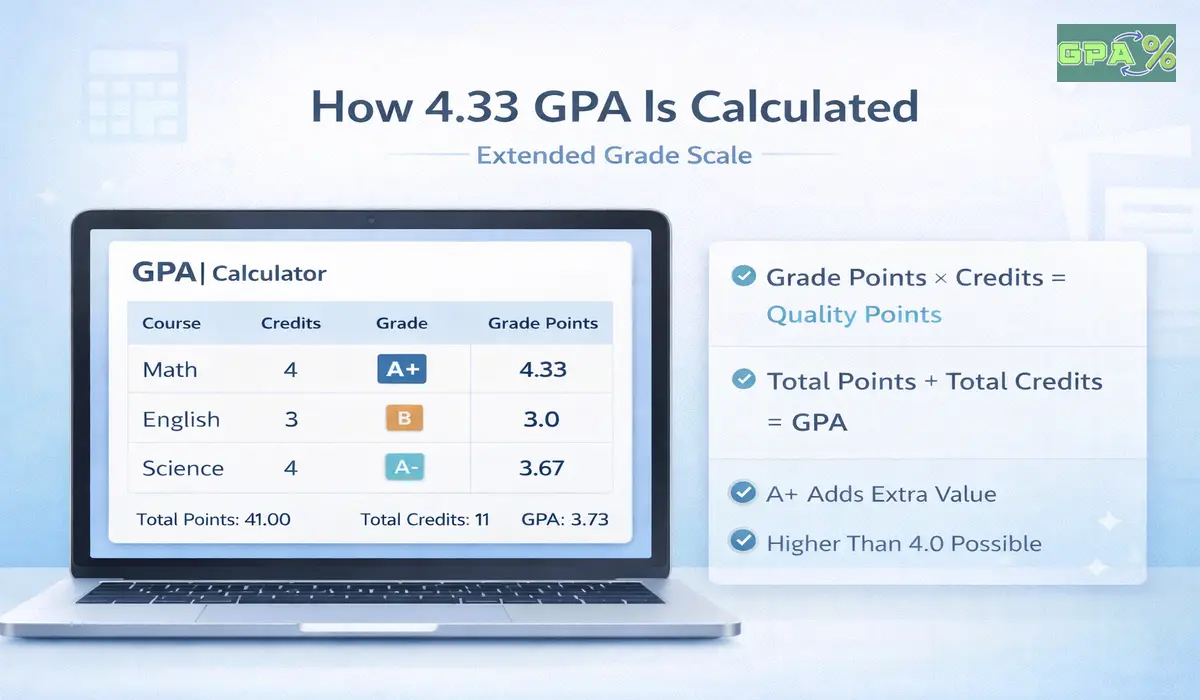
| Course | Credits | Grade | Points | Quality Points |
|---|---|---|---|---|
| Math | 4 | A+ | 4.33 | 17.32 |
| English | 3 | B | 3.00 | 9.00 |
| Science | 4 | A- | 3.67 | 14.68 |
Total quality points = 17.32 + 9.00 + 14.68 = 41.00
Total credits = 4 + 3 + 4 = 11
GPA = 41.00 ÷ 11 = 3.73
This result is slightly higher than what the same grades would produce in a 4.0 scale because the A+ carries additional value.
4.33 GPA vs 4.0 GPA
The difference between these two systems becomes clearer when they are compared directly.
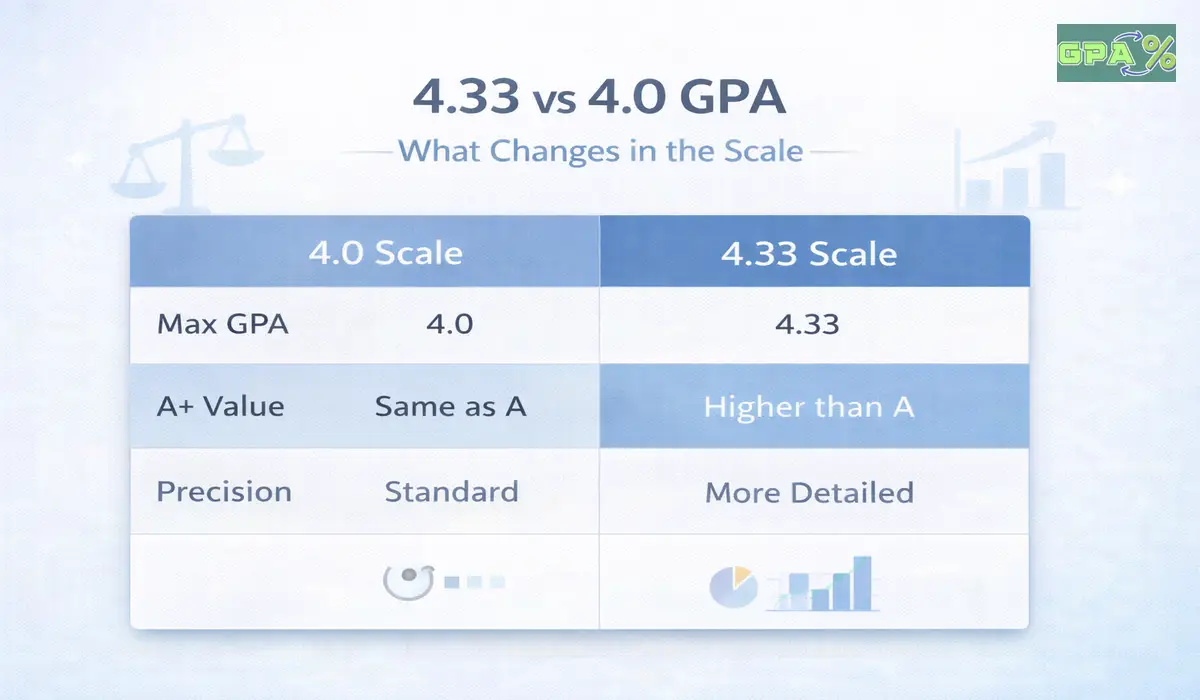
| Factor | 4.0 Scale | 4.33 Scale |
|---|---|---|
| Max GPA | 4.0 | 4.33 |
| A+ value | Same as A | Higher than A |
| Precision | Standard | More detailed |
| Usage | Most schools | Selected schools |
Both systems follow the same calculation method, but the grade values introduce small differences in the final GPA.
Is a 4.33 GPA Weighted or Not
A GPA above 4.0 is often misunderstood as a weighted GPA, but this is not always correct. The 4.33 scale is generally an unweighted system where only the grade values are adjusted.
Weighted GPA depends on course difficulty, such as Honors or AP classes, while the 4.33 scale focuses only on assigning different values to grades. These two concepts operate separately and should not be confused. If you want a broader overview of how these terms are used across U.S. transcripts, read what GPA means in the US system. If you want to see how rigorous courses are defined, the College Board explains what AP courses are.
How the 4.33 Scale Appears on Transcripts
A transcript that follows this system usually shows GPA with a maximum value of 4.33, and the number may appear as something like 3.85 out of 4.33. This format depends on how the institution presents academic records.
The registrar defines the grading structure used by the school, and this information becomes part of the official transcript used in college applications.
How Colleges View the 4.33 GPA
Colleges are familiar with different grading systems, and they review GPA within the correct academic context. A GPA calculated using the 4.33 scale may be compared with other scales through internal evaluation methods.
Admissions teams consider grading scale, course selection, and consistency of performance rather than relying only on the number.
When Students See GPA Above 4.0
A GPA above 4.0 appears in two main situations.
- The grading system assigns a higher value to A+ as part of a 4.33 scale
- The school applies additional points for advanced courses in a weighted GPA system
This distinction is important because both situations produce similar numbers but follow different rules.
Common Mistakes Students Make
- Assuming that a GPA above 4.0 always represents a weighted GPA
- Comparing a 4.33 GPA directly with a 4.0 GPA without context
- Ignoring the grading policy defined by the school
- Misinterpreting the impact of A+ grades on the final GPA
These errors create incorrect conclusions about academic performance and make comparisons unreliable.
How a GPA Calculator Handles the 4.33 Scale
A GPA calculator supports multiple grading systems and applies the correct values to each grade automatically. It converts letter grades into points and combines them with credit hours to produce accurate results.
- Manual calculation often creates confusion when different scales are involved
- A calculator maintains consistency in grade mapping and final output
Reading a 4.33 GPA on a Transcript
A transcript that uses a 4.33 scale usually shows both the GPA value and the maximum scale, for example, 3.85 out of 4.33. This format helps you understand the range in which your performance is measured and avoids confusion when you compare it with a 4.0 system.
You should check three things on the transcript: the grading scale mentioned by the school, the credit hours for each course, and the cumulative GPA value across semesters. These three details together give the full picture of academic performance instead of relying on a single number.
Same Performance, Different GPA Scenario
Two students can complete similar courses with similar grades and still show different GPA values when their schools use different scales.
| Scenario | Student A (4.0 Scale) | Student B (4.33 Scale) |
| Math | A | A+ |
| English | A- | A- |
| Science | B+ | B+ |
| Final GPA | Lower value | Slightly higher value |
The difference appears because the A+ grade in the 4.33 scale adds extra points, even though the overall performance level is similar. This is why direct comparison without checking the grading system creates confusion.
How A+ Impacts GPA Over Time
An A+ grade adds a small increase in grade points, but the impact becomes more visible when multiple semesters are combined. One A+ in a single course creates a small difference, but repeated A+ grades across semesters raise the cumulative GPA more noticeably.
The effect also depends on credit hours. A high credit course with an A+ produces a stronger increase compared to a low credit course. This is why students should look at both grade value and course weight instead of focusing on the grade alone.
Converting 4.33 GPA to 4.0 Scale
Students often try to convert a 4.33 GPA into a 4.0 scale for comparison, but this process is not exact because grading policies vary across institutions. A direct formula may give an approximate value, but it does not reflect how colleges actually evaluate transcripts.
Admissions teams usually review the original transcript and interpret the GPA within the correct grading system instead of relying on a simple conversion. This approach ensures that performance is evaluated in the proper academic context.
How Counselors and Admissions Teams Interpret GPA
School counselors and admissions teams do not rely only on the GPA number when reviewing academic records. They examine the grading scale, course selection, and consistency of performance across semesters.
A GPA from a 4.33 scale is understood as part of the school’s grading system, and colleges often normalize different scales internally before comparing applicants. This process allows fair evaluation across students from different schools.
How to Compare GPA Correctly
A proper comparison between GPA values requires more than looking at the number alone.
- Check the grading scale used by each school
- Look at the course difficulty and credit hours
- Review consistency across semesters
- Avoid direct comparison without context
These steps help you interpret GPA values accurately and avoid incorrect assumptions.
What You Should Focus On as a Student
A student should focus on maintaining consistent performance across courses rather than trying to compare GPA values across different scales. The grading system used by the school already defines how performance is measured.
Colleges evaluate GPA within the correct academic context, so understanding your own grading system is more important than comparing numbers from different systems.
Related Guides
- 4.0 GPA Scale Explained
- How to calculate GPA step by step
- Weighted vs unweighted GPA explained
- GPA vs CGPA: What is the difference
FAQs
What is a 4.33 GPA?
A 4.33 GPA scale allows grades to go slightly above 4.0 by assigning a higher value to A+. It provides a more detailed representation of top level performance.
Is 4.33 better than 4.0?
The 4.33 scale is not better but more detailed. Both systems measure academic performance using slightly different grade values.
Can GPA exceed 4.0?
GPA can exceed 4.0 in systems such as the 4.33 scale or weighted GPA. The reason depends on how grades or course difficulty are evaluated.
Do all schools use the 4.33 scale?
Most schools use the 4.0 scale, while some institutions use the 4.33 scale. The system depends on the grading policy of the school.
Conclusion
A GPA above 4.0 does not indicate an error or an unusual result, but instead reflects a different grading structure that assigns additional value to top grades. When you understand how the 4.33 scale works, you can interpret your transcript accurately and avoid incorrect comparisons while planning your academic progress.