A transcript shows letter grades for each course, but colleges and schools do not evaluate performance using letters alone. A number is assigned to every grade, and that number becomes part of your GPA. Many students see a GPA like 3.6 or 3.8 and understand that it reflects performance, but the way those numbers are created is not always clear.
The 4.0 GPA scale is the standard grading system used across most U.S. high schools and colleges. This system converts letter grades into grade points, and those points are then used with credit hours to calculate GPA. When you understand how this scale works, reading a transcript becomes easier, and planning your academic performance becomes more accurate.
What Is the 4.0 GPA Scale
The 4.0 GPA scale is a grading system that assigns numeric values to letter grades. Each grade you receive in a course is converted into a point value, and the highest value in this system is 4.0.
This scale is used in both high school and college, and it forms the foundation for calculating semester GPA and cumulative GPA. Every course grade is translated into a number, which allows schools to measure academic performance in a consistent format.
Letter Grades to GPA Points
The conversion from letter grades to grade points follows a standard pattern in most schools.
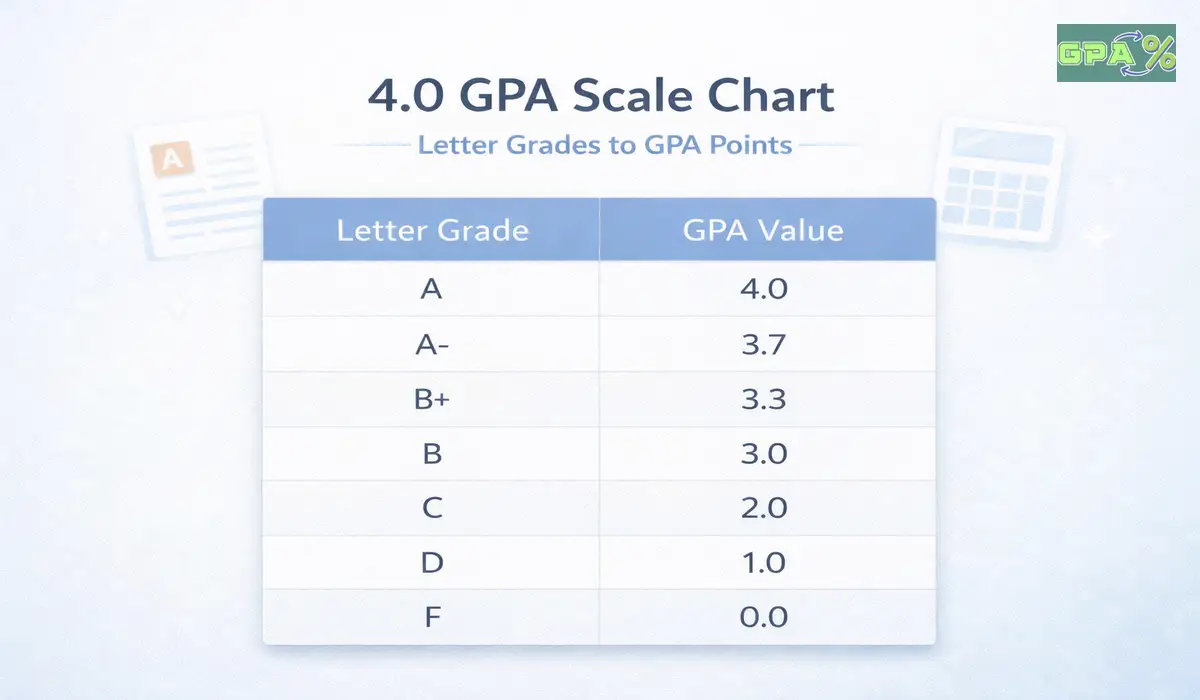
| Letter Grade | GPA Value (4.0 Scale) |
|---|---|
| A | 4.0 |
| A- | 3.7 |
| B+ | 3.3 |
| B | 3.0 |
| B- | 2.7 |
| C+ | 2.3 |
| C | 2.0 |
| D | 1.0 |
| F | 0.0 |
Each step between grades creates a noticeable change in GPA. A small drop from A to A- may look minor, but it affects the final GPA when combined with credit hours.
How Schools Handle A+ and A-
Different schools may handle grade variations slightly differently. Some schools treat A+ the same as A, while others assign a slightly higher value in extended grading systems. In most 4.0 scale systems, A and A+ are treated as 4.0.
An A- reduces the grade point slightly, which means even a small grade change can affect GPA when multiple courses are involved. The exact mapping should always be checked in the school’s grading policy or transcript guide, and BigFuture shows how GPA is calculated on a 4.0 scale.
How the 4.0 Scale Is Used in GPA Calculation
The 4.0 scale connects directly to GPA calculation. Each grade converts into points, and those points are combined with credit hours to produce a final GPA.
The process follows three steps:
- Letter grades convert into grade points
- Grade points multiply by credit hours
- Total quality points divided by total credits
This method applies to both semester GPA and cumulative GPA.
Real Example Using the 4.0 Scale
A full example shows how the scale works in practice.
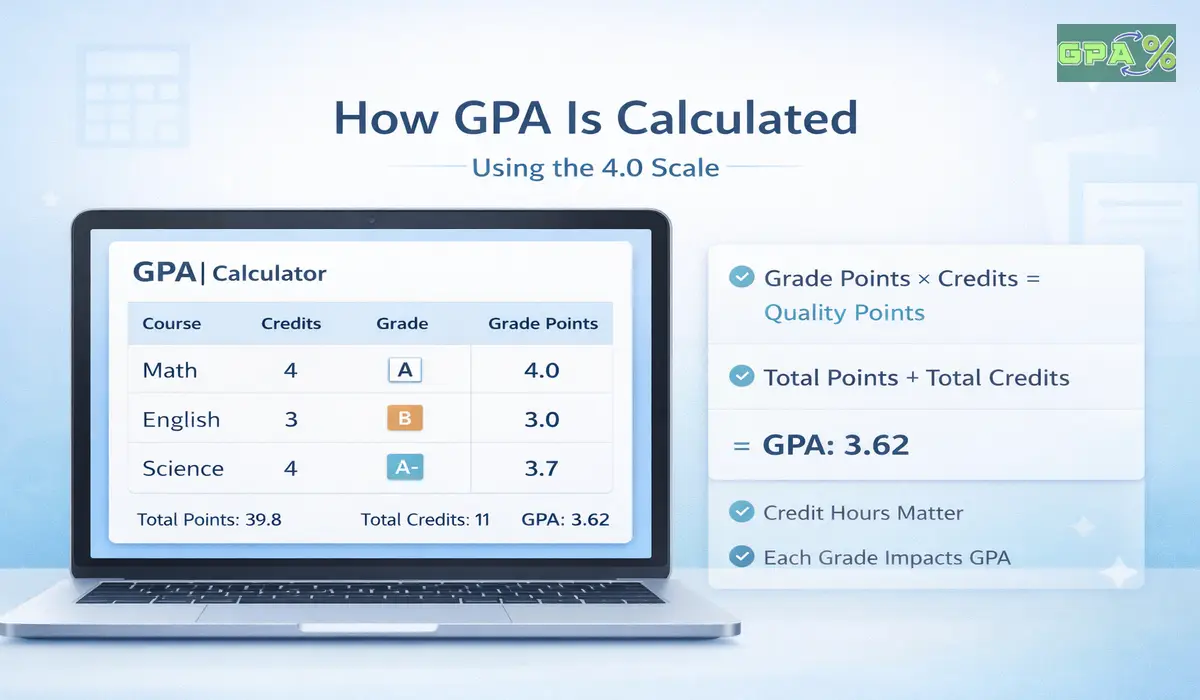
| Course | Credits | Grade | Points | Quality Points |
|---|---|---|---|---|
| Math | 4 | A | 4.0 | 16.0 |
| English | 3 | B | 3.0 | 9.0 |
| Science | 4 | A- | 3.7 | 14.8 |
Total quality points = 16.0 + 9.0 + 14.8 = 39.8
Total credits = 4 + 3 + 4 = 11
GPA = 39.8 ÷ 11 = 3.62
This number reflects both the grades and the weight of each course.
Why the 4.0 Scale Is Widely Used
The 4.0 scale is used across most institutions because it creates a standard format for evaluating students.
- Colleges can compare applicants more easily
- Schools maintain consistency in grading systems
- GPA becomes easier to interpret across transcripts
- Academic performance can be tracked clearly over time
This consistency helps admissions teams to review their students from different schools using a common reference.
Limitations of the 4.0 Scale
The 4.0 scale does not always show the full academic picture.
- Course difficulty is not reflected directly
- Advanced classes carry the same base value as regular classes
- Academic rigor is not visible in the number alone
- Students taking challenging courses may not appear different
This is why many schools also use weighted GPA systems.
How the 4.0 Scale Appears on Transcripts
A U.S. transcript usually includes course names, letter grades, credit hours, and GPA values. Semester GPA shows performance for one term, while cumulative GPA shows overall performance across all terms.
A registrar records these values using the school’s grading system, and the transcript becomes the official academic record colleges expect to review.
How Colleges Use the 4.0 Scale
Colleges use GPA to evaluate academic performance during admissions. The 4.0 scale provides a standard reference that allows comparison between applicants.
Admissions teams review GPA along with course selection, grading scale, and consistency of performance. GPA is one part of the evaluation, but it plays a central role in shortlisting candidates.
Common Mistakes Students Make
- Assuming all schools follow the exact same 4.0 scale
- Ignoring the impact of A- or B+ on GPA
- Mixing 4.0 scale with 4.33 scale calculations
- Converting a percentage directly without proper mapping
These mistakes create incorrect GPA expectations and confusion during planning.
When the 4.0 Scale Is Not Enough
The 4.0 scale does not reflect course difficulty, which is why some schools use extended systems.
- Honors, AP, and IB courses may require a weighted GPA
- Some schools use a 4.33 scale for additional precision
Students who take advanced courses may see a different GPA structure depending on the system used. If you want to compare that extended format directly, see how the 4.33 GPA scale works.
How a GPA Calculator Uses the 4.0 Scale
A GPA calculator applies the 4.0 scale automatically by converting grades into points and combining them with credit hours.
- Manual calculation can lead to small errors
- A calculator ensures correct grade mapping and accurate results
The calculator also helps you test different scenarios and understand how grade changes affect GPA.
Related Guides
- What is GPA, and how does it work in the US
- How to calculate GPA step by step
- Weighted vs unweighted GPA explained
- GPA vs CGPA: What is the difference
FAQ
What is a perfect GPA on a 4.0 scale?
A perfect GPA on a 4.0 scale is 4.0. It means every course has the highest grade, such as an A.
Can GPA exceed 4.0?
GPA can go above 4.0 in weighted systems where advanced courses carry extra points. In a standard 4.0 system, the maximum stays at 4.0.
Do all schools use the 4.0 scale?
Most schools use the 4.0 scale, but some follow variations like 4.33 or weighted grading. The exact system depends on the school’s policy.
What is A- in GPA?
An A- usually converts to 3.7 on the 4.0 scale. This difference can lower GPA when several courses are included.
Is a 4.0 GPA always the best?
A 4.0 GPA shows the highest performance in an unweighted system. In weighted systems, higher values may appear due to advanced courses.
Conclusion
The 4.0 GPA scale forms the foundation of academic evaluation in the U.S. system. A clear understanding of how letter grades convert into points helps you interpret your transcript correctly and calculate your GPA without confusion. This knowledge also makes it easier to plan courses and understand how each grade affects your academic progress.