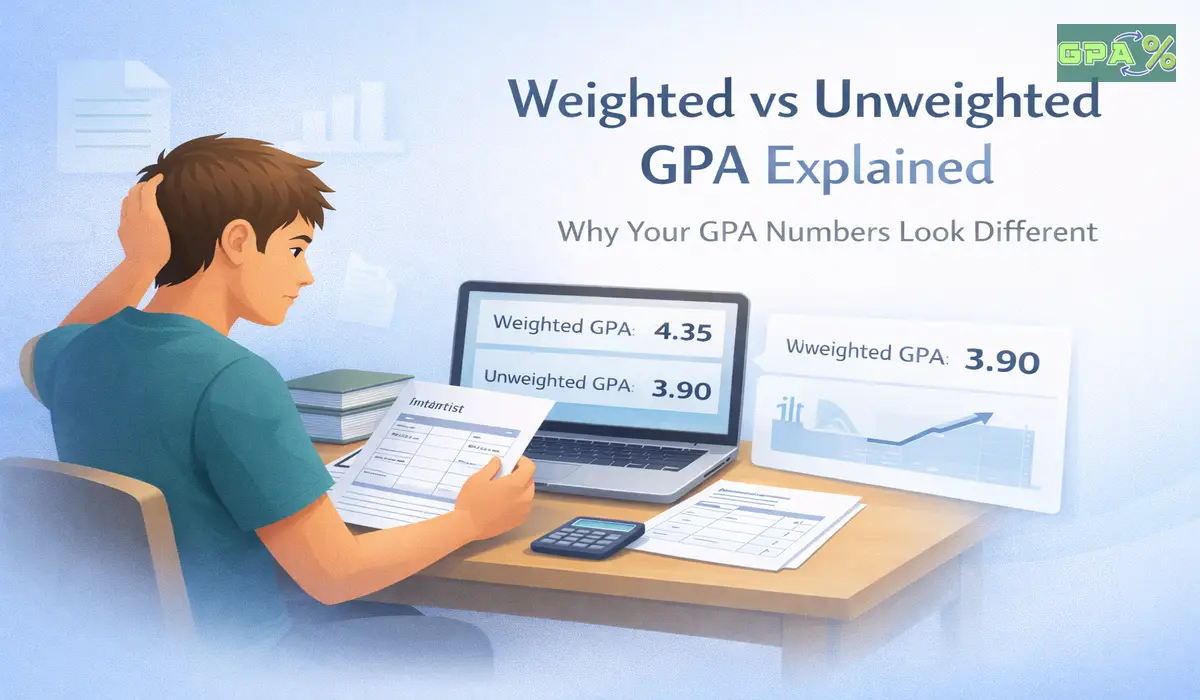
If you have ever looked at your transcript and noticed two different GPA numbers, then you are not alone. Many students see both weighted and unweighted GPAs and start wondering why the numbers are different, even when the grades look the same.
The thing is that both numbers are correct, but they measure your performance in slightly different ways, and understanding this difference can help you make better decisions about your courses, your academic goals, and even your college applications.
This guide explains what weighted and unweighted GPAs mean in the United States, how they are calculated, how Honors, AP courses, and IB courses affect your GPA, and how colleges actually look at both numbers when reviewing applications.
What is an unweighted GPA?
Unweighted GPA is the standard way of measuring academic performance, and it uses a fixed scale, usually up to 4.0, where every course is treated equally, regardless of difficulty. If you want to review the standard method in more detail, see how GPA is calculated on a 4.0 scale.
In this system, the grade you earn directly converts into grade points, and there are no extra points added for taking more challenging courses.
| Grade | Unweighted GPA |
|---|---|
| A | 4.0 |
| B | 3.0 |
| C | 2.0 |
| D | 1.0 |
| F | 0.0 |
The main thing is that an A in a regular class and an A in an advanced class both carry the same value in an unweighted system, which makes it easier to compare performance but does not reflect course difficulty.
What Is Weighted GPA
Weighted GPA is designed to recognize the effort required for more challenging courses, and because of this, schools add extra grade points for advanced classes such as Honors, Advanced Placement (AP), and International Baccalaureate (IB).
This means that the same grade can have a higher value depending on the course level, and this is why weighted GPA can go above 4.0.
| Course Type | Grade | Weighted GPA |
|---|---|---|
| Regular | A | 4.0 |
| Honors | A | 4.5 |
| AP or IB | A | 5.0 |
The thing is that each school may use a slightly different system, so the exact values should always be confirmed through the transcript guide or a school counselor.
Key Differences Between Weighted and Unweighted GPA
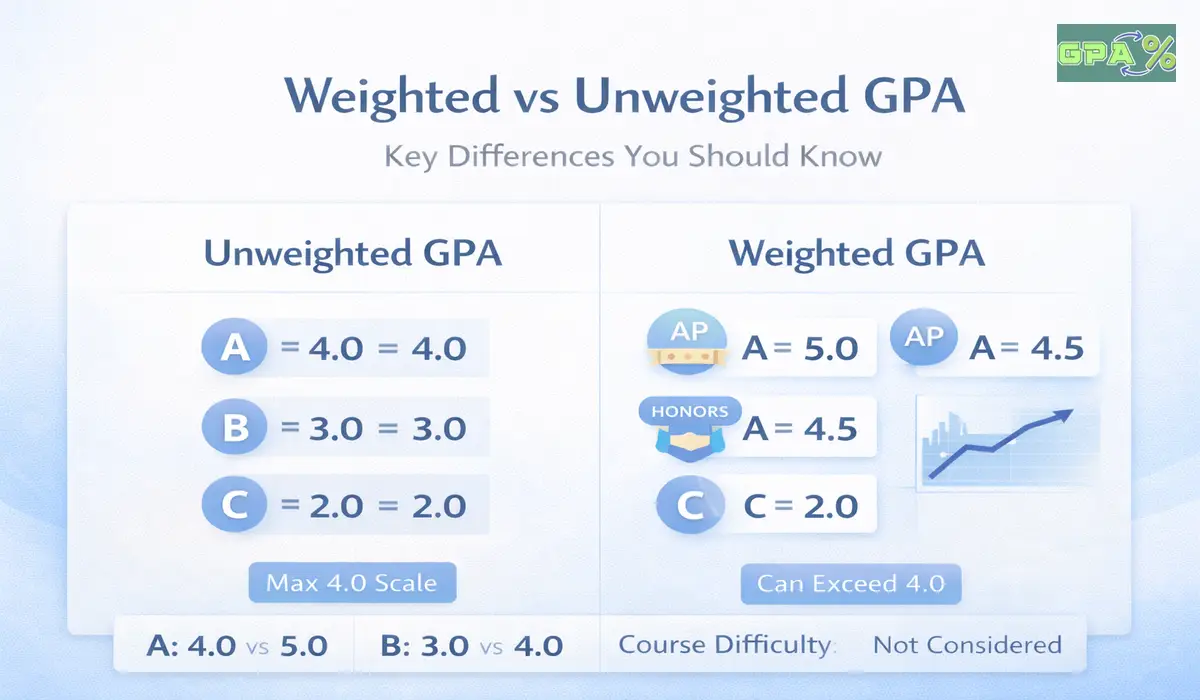
The difference becomes clearer when you compare both systems side by side.
| Factor | Unweighted GPA | Weighted GPA |
|---|---|---|
| Scale | Up to 4.0 | Can exceed 4.0 |
| Course difficulty | Not considered | Considered |
| Honors and AP impact | No extra points | Extra points added |
| GPA range | Limited | Higher possible range |
This comparison shows that unweighted GPA focuses on grades alone, while weighted GPA also considers how challenging your courses are.
Real Example to Understand the Difference
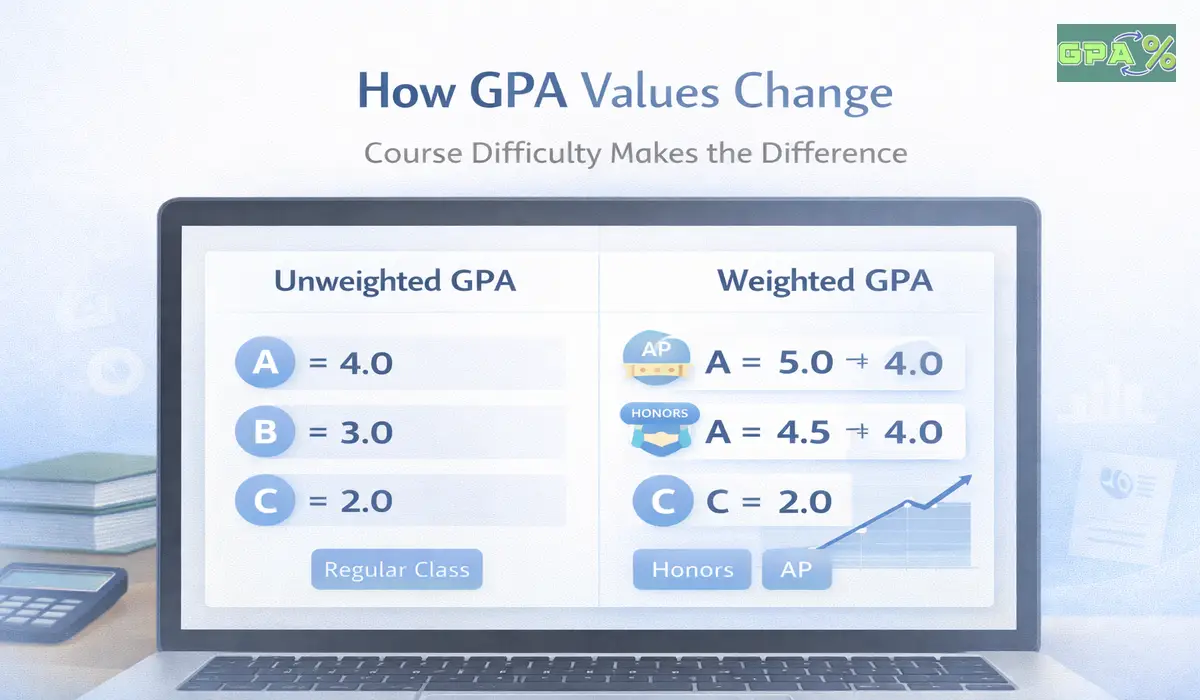
A simple example makes this concept much easier to understand.
Two students earn the same grades across their classes, but they choose different course levels.
Student One takes regular classes and earns all A grades, which results in an unweighted GPA of 4.0 and a weighted GPA that also stays close to 4.0.
Student Two takes Honors and AP classes and also earns all A grades, but the weighted GPA increases to around 4.5 or higher because of the extra points added for course difficulty.
The thing is that both students performed equally well in terms of grades, but the second student took more challenging courses, and that is reflected in the weighted GPA.
Why Schools Use Weighted GPA
Schools use weighted GPA to encourage students to take academically challenging courses instead of choosing easier classes just to maintain a high average.
- It rewards students who take Honors, AP, or IB courses
- It helps schools differentiate between students with similar grades
- It supports class ranking by considering course difficulty
- It gives a more complete view of academic effort
This approach ensures that students are not discouraged from taking advanced classes.
How Colleges View Weighted and Unweighted GPAs?
Colleges usually look at both weighted and unweighted GPAs, but they do not rely on these numbers alone.
Admissions teams often review the transcripts in detail, and they may recalculate the GPA using their own standards to create a fair comparison between applicants from different schools.
The thing is that colleges focus on two main factors, which are consistency in grades and the level of course difficulty.
A strong academic record usually includes both good grades and a willingness to take challenging courses when available.
Which GPA Matters More
There is no single answer because both types of GPA provide useful information.
Unweighted GPA shows how consistent your grades are across all classes, while weighted GPA shows how challenging your coursework has been.
The main thing is that colleges look at the full picture, and both numbers together give a better understanding of your academic performance. For a broader explanation of the U.S. grading system, read what GPA means in the U.S.
Common Mistakes Students Make
Many students misunderstand how these systems work, and this leads to confusion when comparing GPAs.
- Thinking that a weighted GPA is always more important than an unweighted GPA
- Comparing GPA with friends without considering course difficulty
- Ignoring the impact of Honors or AP classes
- Using the wrong grading scale for calculation
These mistakes can show you incorrect assumptions about academic performance.
How This Affects GPA Calculation
The calculation method remains the same, but weighted GPA changes the grade points used in the formula.
Credits still play an important role, and the final GPA is still calculated using total quality points divided by total credits.
You can learn more about the calculation process in the guide on how to calculate GPA step by step.
How a GPA Calculator Handles Weighted and Unweighted GPA
A GPA calculator makes the process easy by allowing you to enter course grades, credit hours, and course levels in one place.
- It calculates both weighted and unweighted GPA automatically
- It adjusts grade points based on course level
- It helps you compare results instantly
- It allows you to test different academic scenarios
You can use our GPA calculator to check both values and understand how your course choices affect your GPA.
When Schools Do Not Use Weighted GPA
Some schools use only unweighted GPA, especially when they want to keep grading systems simple and consistent.
In these cases, course difficulty is still considered during evaluation, but it may not appear directly in the GPA number.
Colleges are aware of these differences and often adjust their evaluation methods accordingly.
FAQs
What is a good weighted GPA?
A good weighted GPA depends on your school system and course difficulty. Many competitive students aim for a GPA above 4.0 when advanced courses are included.
Can GPA go above 4.0?
Yes, weighted GPA can go above 4.0 because extra points are added for Honors, AP, or IB classes. The exact limit depends on your school’s grading scale.
Do all schools use weighted GPA?
No, some schools only use unweighted GPA, while others show both values. It depends on the school’s grading policy.
Do colleges prefer weighted GPA?
Colleges look at both weighted and unweighted GPAs along with course difficulty. They often review the full transcript instead of relying on one number.
Are AP classes worth it for GPA?
AP classes can increase weighted GPA and show academic rigor. They are often considered valuable for college admissions when managed properly.
Final Thoughts
Understanding the difference between weighted and unweighted GPA helps you see how your grades and course choices work together to shape your academic record.
The main thing is that both numbers matter, and a balanced approach that includes strong grades and challenging coursework usually creates the best academic profile for future opportunities.