Most students know that GPA matters, but the actual calculation still creates confusion because grades, credits, semester results, and cumulative totals all appear together on a transcript.
The thing is that once the calculation process becomes clear, reading a transcript feels easier, course planning becomes more accurate, and mistakes that affect admissions or scholarship reviews can be avoided.
This guide explains how to calculate GPA step by step using real examples, tables, and practical situations that fit both high school and college settings in the United States. You will see how credits, grading scales, and course levels change the final number. For an official overview of the standard method, the College Board explains how to calculate GPA on a 4.0 scale.
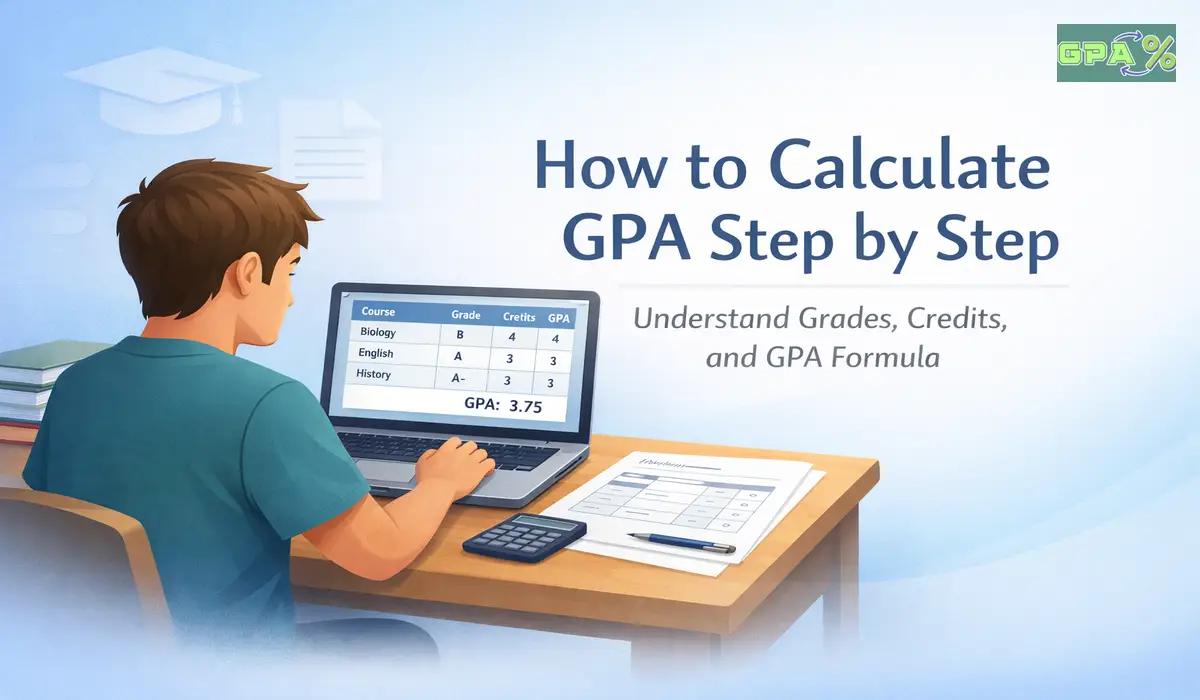
What You Need Before Calculating GPA
Accurate inputs matter more than fast math, because one missing detail can change the final result.
| What you need | Why it matters |
|---|---|
| Course names | Keeps each class organized |
| Letter grades | Convert into grade points |
| Credit hours | Decide how much each class affects GPA |
| Grading scale | Confirms 4.0 or 4.33 mapping |
| Course level | Needed for weighted GPA, such as Honors or AP |
The main thing is that transcripts or the school portal usually contain these details, and official values should be used instead of estimates.
The GPA Formula in Plain Terms
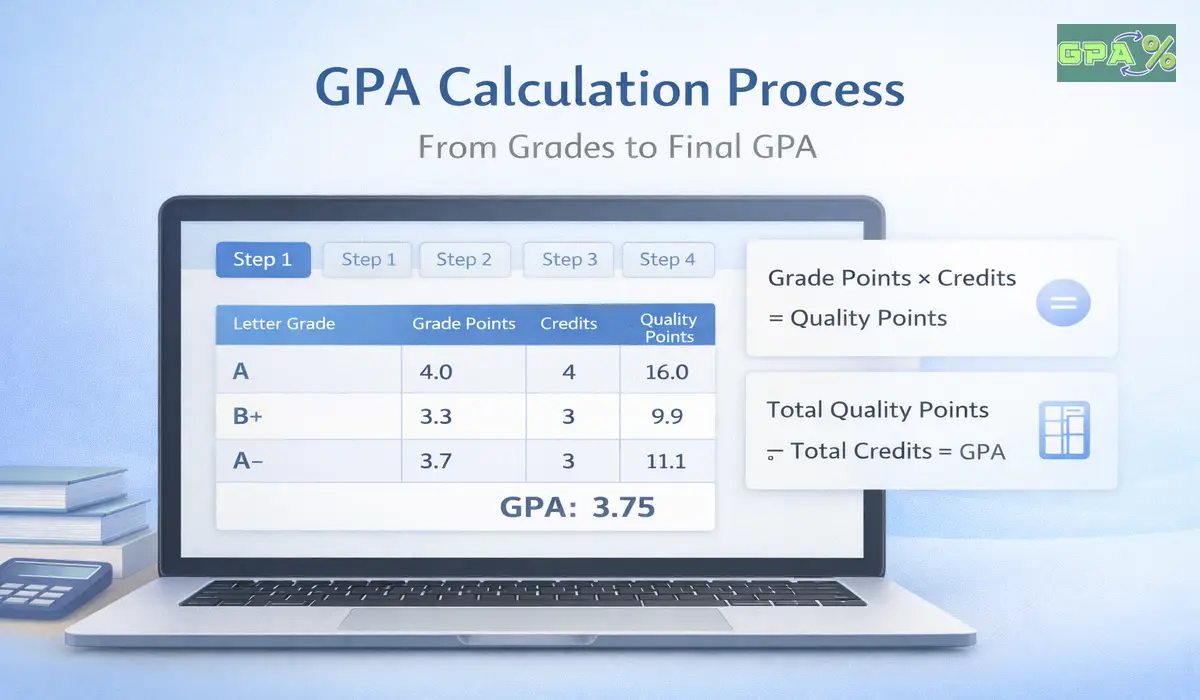
The calculation follows a consistent pattern across most U.S. schools, even though small variations may exist.
The process has three clear parts. Letter grades convert into grade points. Those points are multiplied by credit hours to produce quality points. The total quality points are then divided by total credits.
GPA = Total Quality Points ÷ Total Credits
| Term | Meaning |
|---|---|
| Grade points | Numeric value of a letter grade |
| Credits | Weight of a course |
| Quality points | Grade points multiplied by credits |
| GPA | Final average value |
This structure applies to both semester GPA and cumulative GPA.
Step 1: Convert Letter Grades into Grade Points
Each course grade is first mapped to grade points using the school’s grading scale.
| Letter Grade | 4.0 Scale | 4.33 Scale |
|---|---|---|
| A+ | 4.0 | 4.33 |
| A | 4.0 | 4.0 |
| A- | 3.7 | 3.67 |
| B+ | 3.3 | 3.33 |
| B | 3.0 | 3.0 |
| B- | 2.7 | 2.67 |
| C+ | 2.3 | 2.33 |
| C | 2.0 | 2.0 |
| D | 1.0 | 1.0 |
| F | 0.0 | 0.0 |
The thing is that schools may treat A plus and minus differently, so the transcript guide or registrar page should be checked before using a scale.
Step 2: Multiply Grade Points by Credits
Course weight comes from credit hours, and this is where GPA becomes a weighted average.
| Course | Credits | Grade Points | Quality Points |
|---|---|---|---|
| Biology | 4 | 3.0 | 12.0 |
| English | 3 | 4.0 | 12.0 |
| Lab | 1 | 4.0 | 4.0 |
A higher credit class carries more influence, which means performance in that class changes the GPA more than a low credit elective.
Step 3: Add All Quality Points and Credits
After each course has quality points, totals are calculated for both quality points and credits.
| Total Quality Points | Total Credits |
|---|---|
| 48.7 | 14 |
This step looks simple, but accuracy depends on including every course with the correct credit value.
Step 4: Divide to Get GPA
The final value is found by dividing total quality points by total credits.
48.7 ÷ 14 = 3.48 GPA
This number represents the average academic performance for the selected courses.
Full Example of Semester GPA
A complete example makes the process easier to follow.
| Course | Credits | Grade | Grade Points | Quality Points |
|---|---|---|---|---|
| Algebra II | 4 | A- | 3.7 | 14.8 |
| English Composition | 3 | B+ | 3.3 | 9.9 |
| Biology | 4 | B | 3.0 | 12.0 |
| U.S. History | 3 | A | 4.0 | 12.0 |
| Total | 14 | 48.7 |
Quality points sum to 48.7, and credits sum to 14. Dividing 48.7 by 14 gives 3.48 as the semester GPA.
How to Calculate Cumulative GPA
Cumulative GPA combines results from all completed semesters and shows overall performance.
| Term | Quality Points | Credits | GPA |
|---|---|---|---|
| Fall | 30.0 | 10 | 3.00 |
| Spring | 42.0 | 12 | 3.50 |
| Total | 72.0 | 22 | 3.27 |
Totals across terms are added first, and then 72.0 is divided by 22 to get 3.27 as the cumulative GPA.
How to Calculate Weighted GPA
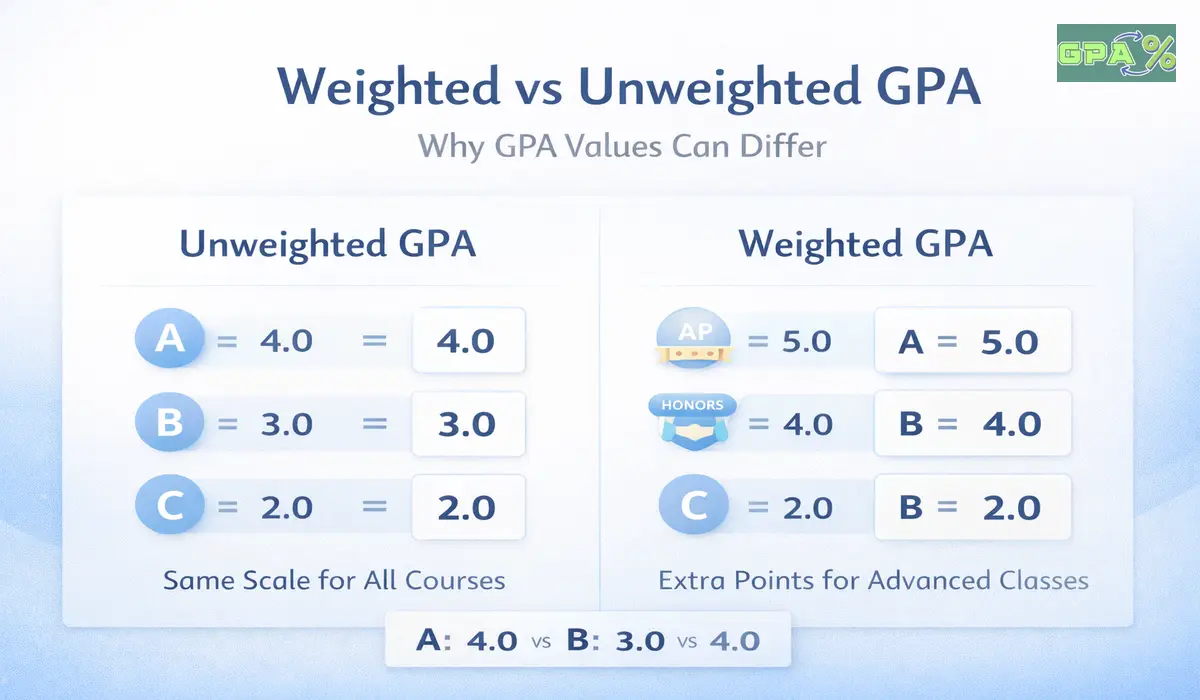
Some schools give extra points for advanced courses such as Honors, AP, or IB, which changes the grade points before the final calculation.
| Course | Level | Base Points | Extra Points | Weighted Points |
|---|---|---|---|---|
| English | Regular | 4.0 | 0.0 | 4.0 |
| Biology | Honors | 3.0 | 0.5 | 3.5 |
| Algebra | AP | 3.7 | 1.0 | 4.7 |
School policy controls the extra points, so the counselor’s guide or transcript notes should be checked for exact values.
How to Calculate Unweighted GPA
Unweighted GPA uses the same scale for all courses, regardless of difficulty.
| GPA Type | Course Treatment |
|---|---|
| Unweighted GPA | All courses use the same base scale |
| Weighted GPA | Advanced courses can receive extra points |
This difference matters because colleges may review both values in different ways.
Common Mistakes That Change GPA
Small errors can change the result even when the steps look correct.
- Percentage values are used instead of proper letter to point mapping
- Credit hours are ignored, and all classes are treated equally
- Weighted and unweighted values are mixed in one calculation
- The wrong grading scale is applied to the school
These issues can shift the final number and affect admissions planning or scholarship checks.
Special Situations That Affect GPA
Some transcript cases follow different rules and should be verified.
- Pass or fail courses may count for credits, but not for grade points
- Repeated courses may replace earlier grades or be averaged
- Transfer credits may count toward progress, but not always toward GPA
- Withdrawals may appear without changing GPA in the same way as graded classes
Registrar policies or the school handbook provide the correct handling for these cases.
When to Use a GPA Calculator
Manual math is useful for learning the formula, but it becomes harder with many courses or several terms.
- Manual calculation works for a small set of classes
- A calculator works better for semester and cumulative tracking
You can use our GPA calculator to enter grades, credits, and course levels and check results quickly.
How the GPA Calculator Helps
A calculator brings all inputs together and shows results without manual errors.
- Enter grades and credit hours for each course
- See the semester GPA and the cumulative GPA together
- Include weighted values for Honors, AP, or IB courses
- Test scenarios before final grades are posted
This creates a clear view of current standing and the changes needed in the next term.
Related Guides
These pages build a complete understanding of GPA.
- What is GPA, and how does it work in the US
- Weighted vs unweighted GPA explained
- Use the GPA calculator to check your results
FAQ
What is the formula for GPA?
The GPA formula is based on quality points and total credits. A student converts grades into points, multiplies by credits, and divides total quality points by total credits.
How do credits affect GPA?
Credits decide how much each course impacts your GPA. A higher credit class affects your GPA more than a lower credit class with the same grade.
How do I calculate cumulative GPA?
Cumulative GPA combines all semesters. A student adds all quality points and credits from every term, then divides to get the final GPA.
How do I calculate weighted GPA?
Weighted GPA includes extra points for Honors, AP, or IB courses. A student adds these extra points before calculating GPA using the same formula.
Why does my GPA differ from my transcript?
A GPA may differ due to school rules like grading scale, rounding, or course inclusion. The official GPA from the registrar should always be treated as correct.
Final Thoughts
The main thing is that GPA calculation becomes easy once you understand how grade points, credits, and quality points work together.
A student who follows the correct steps can calculate GPA accurately and avoid confusion when reviewing transcripts or planning future courses.
You should also use a GPA calculator to verify your results and make sure your calculations match official records.