A student usually wants to understand one clear thing at the beginning, and that is what this number called GPA really means in day to day academic life in the United States, and how this number connects to classes, transcripts, college admissions, and scholarship reviews that you hear about so often during high school and college.
The thing is that GPA looks like just a number on paper, but it actually reflects how you performed across different courses that carry different credit hours, and because of this, the way it is calculated and interpreted becomes very important when you plan your semesters or review your transcript with a counselor.
This guide explains GPA in a simple manner, and it walks you through how it is calculated, how credits affect it, how semester and cumulative GPAs differ, and how you can check your own numbers using a GPA calculator without making common mistakes.

What GPA Means
GPA stands for Grade Point Average, and it represents your academic performance across all the courses you take within a term or across multiple terms.
In the United States, schools use letter grades instead of percentages for GPA calculations, and each letter grade is converted into a numeric value that is called grade points, which are then used in the calculation.
The main thing is that GPA is not only about grades, and this is where many students get confused, because every course also has a credit value, and that credit value decides how much impact that course will have on your final GPA.
What you need to understand is that the GPA is always calculated using both your grades and your credit hours together, not just one of them.
How GPA Is Calculated
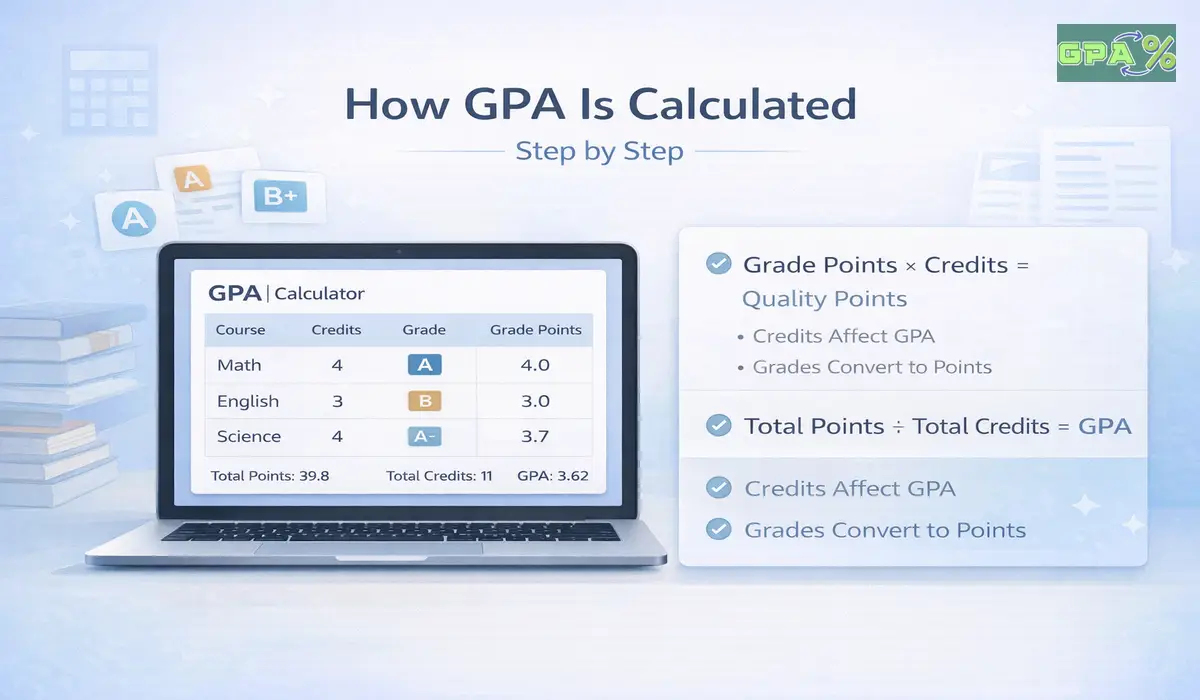
The process follows a fixed pattern, and once you understand this pattern, you can calculate GPA for any semester or for your full academic record.
First, each letter grade is converted into grade points based on the grading scale used by your school.
Second, those grade points are multiplied by the credit hours of each course, which gives you what is called quality points.
Third, all quality points are added together across all your courses. At last, the total quality points are divided by the total credit hours.
The formula looks like this.
GPA = Total Quality Points ÷ Total Credits
This is the exact method used by schools, colleges, and registrars when they calculate GPA on official transcripts.
Letter Grade to Point Mapping
This table shows a common 4.0 scale used by many schools, although you should always check your own school policy.
| Letter Grade | Grade Points |
|---|---|
| A | 4.0 |
| A- | 3.7 |
| B+ | 3.3 |
| B | 3.0 |
| B- | 2.7 |
| C+ | 2.3 |
| C | 2.0 |
| D | 1.0 |
| F | 0.0 |
Real Example of GPA Calculation
Let me explain this with a complete example so you can clearly see how each part works together, because this is where most students start understanding the concept properly.
A student takes three courses in one semester, and each course has a different credit value and grade.
| Course | Credits | Grade | Grade Points | Quality Points |
|---|---|---|---|---|
| Math | 4 | A | 4.0 | 16.0 |
| English | 3 | B | 3.0 | 9.0 |
| Science | 4 | A- | 3.7 | 14.8 |
Now you add all quality points.
16.0 + 9.0 + 14.8 = 39.8
Now you add all credits.
4 + 3 + 4 = 11
Now divide total quality points by total credits.
39.8 ÷ 11 = 3.62
So the semester GPA becomes 3.62, and this number reflects both the grades and the weight of each course based on credits.
Semester GPA vs Cumulative GPA
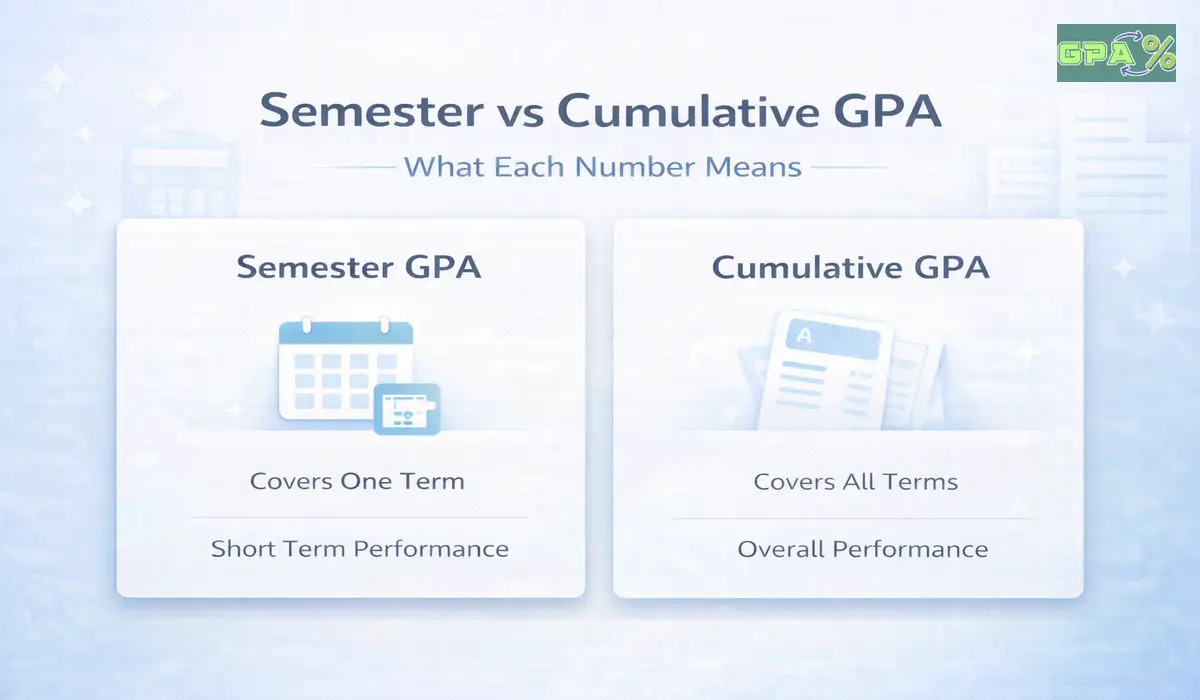
The thing is very clear, and that is the GPA is not always one single number because it can be calculated for a specific term or across all completed terms.
Semester GPA is calculated for one term only, and it shows how you performed in that particular semester.
Cumulative GPA is calculated across all your completed semesters, and it shows your overall academic performance over time.
You will usually see both of these numbers on your transcript, and colleges often pay more attention to cumulative GPA because it reflects consistency across multiple terms.
Credits and Why They Matter
Credits play a very important role in GPA, and this is something many students do not notice at first, but it becomes very important when you try to improve your GPA.
A course with higher credit hours carries more weight in GPA calculation, so your performance in that course will affect your GPA more compared to a low credit course.
For example, if you improve your grade in a 4 credit course, the impact on your GPA will be higher than improving a grade in a 1 credit course, because more quality points are involved in the calculation.
You should keep this in mind while planning your study time, especially when you are trying to raise your GPA before an important semester or application cycle.
Weighted vs Unweighted GPA
In the United States, schools may use two types of GPA systems depending on how they treat advanced courses.
An unweighted GPA follows a standard scale, usually up to 4.0, in which all courses are treated equally, regardless of difficulty.
Weighted GPA adds extra grade points for advanced courses such as Honors, AP, or IB, and because of this, a student taking more advanced courses can have a GPA above 4.0.
You should know these differences clearly because your transcript may show one or both values, and colleges may interpret them differently depending on their admission process.
If you want a closer look at how advanced courses can affect weighting decisions, see what AP courses are on the College Board site, because AP coursework is one of the most common reasons a weighted GPA rises above an unweighted 4.0 scale.
Why GPA Is Important in the US
GPA plays a central role in academic evaluation, and you will see its importance in several real situationsCollege admissions offices may also look at class rank when they review academic context, which is one reason GPA remains important beyond a single report card or semester result.
- Colleges use GPA to compare applicants and understand academic performance across different schools
- Scholarship programs use GPA as a minimum eligibility requirement or as a ranking factor
- Schools use GPA to calculate class rank and academic standing
- Counselors use GPA to guide course selection and academic planning
The thing is that GPA is not just a number on your report; it directly affects opportunities available to you in both high school and college.
Where Students Get Confused
Many students make small mistakes that lead to a wrong GPA understanding, and these mistakes can create confusion when planning future semesters.
- Some students mix GPA with CGPA and assume both are exactly the same in every system
- Some students try to convert a percentage directly into GPA without using the correct grade mapping
- Some students ignore credit hours and only focus on letter grades
- Some students do not understand how weighted GPA works for advanced courses
The thing is that these mistakes may look small, but they can lead to incorrect calculations and wrong academic planning.If you want to understand how GPA terms overlap with other academic scoring systems, read CGPA vs OGPA vs SGPA vs GPA, because that guide helps clarify where students often mix GPA language across different systems.
How the GPA Calculator Helps
When you calculate GPA manually, you may face issues with rounding, incorrect multiplication, or missing credit values, and this is where a calculator becomes useful.
What I usually do is, I simply enter all course grades and credits into a GPA calculator and check both semester and cumulative results at the same time so that I do not miss any detail.
You can use our GPA calculator to:
- Enter grades and credits for each course
- Check the semester GPA and the cumulative GPA together
- Add course levels like Honors or AP for weighted results
- Test different scenarios to see how your GPA changes
This gives you a clear picture of where you stand and what you need to improve in the next term.
Related Guides
You should also check these pages to understand GPA better and build a complete understanding of the topic.If you want a school level example, our guide on how to calculate your GPA in high school explains how GPA is usually read and calculated in a common US school setting.
- How to calculate GPA step by step
- Weighted vs unweighted GPA explained
- Use the GPA calculator to check your results
FAQs
What is a good GPA in the US?
A good GPA depends on your school, your grade level, and your target colleges, but many competitive colleges expect a GPA above 3.5 for strong consideration.
Is GPA the same in all schools?
No, different schools may use different grading scales, credit systems, and weighting methods, so GPA values can vary across institutions.
Can GPA be higher than 4.0?
Yes, in weighted GPA systems, students taking advanced courses can have a GPA above 4.0 because of additional grade points.
How often is GPA updated?
GPA is usually updated at the end of each semester or term when final grades are recorded.
Final Thoughts
The main thing is that GPA is calculated using both grades and credits, and it reflects your academic performance across time rather than just one exam or one subject.
Once you understand how GPA works, you can plan your courses better, focus on high credit classes, and make informed decisions that improve your academic record.
You should also use a GPA calculator regularly to check your progress and make sure your calculations are accurate before making any academic decisions.