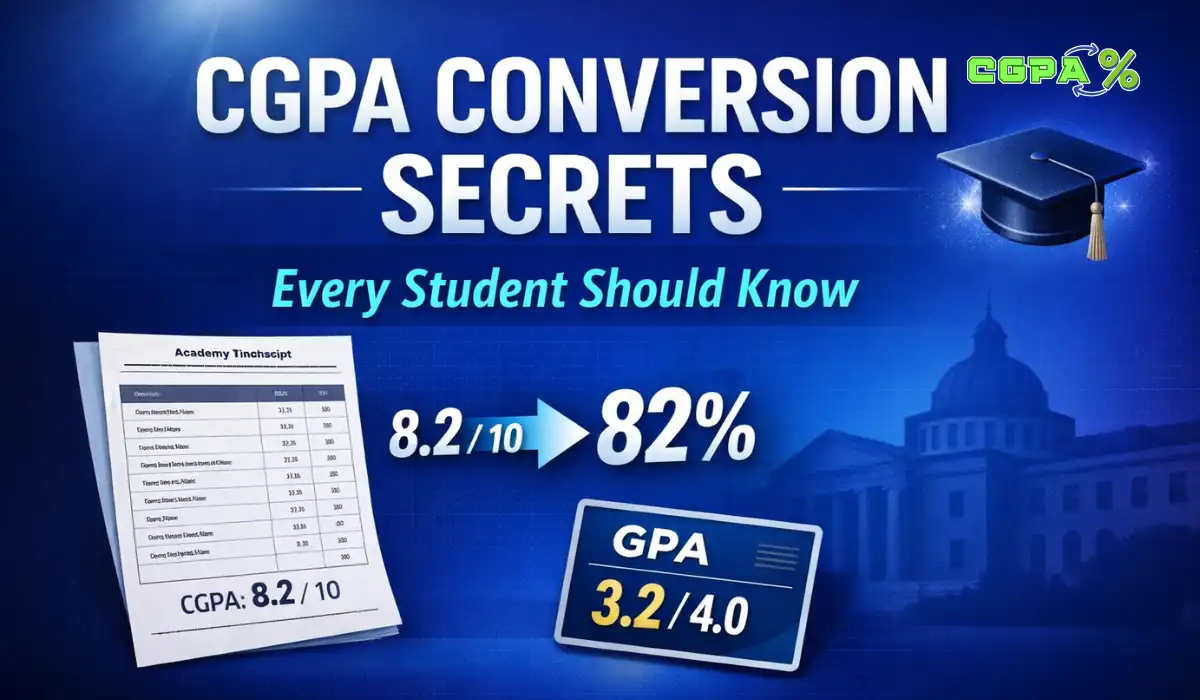
Understanding What CGPA Actually Represents
A Cumulative Grade Point Average represents a student’s overall academic performance across completed semesters. It is calculated using the grade points assigned to each subject and the credit weight of each subject. Universities use CGPA as a standardized academic performance indicator recorded on official transcripts.
Different institutions follow different grading scales. Some universities use a 10-point scale. Others follow a 4.0 scale. Certain institutions use percentage type of systems. This difference creates complications when students apply outside their home university system.
CGPA is not only a classroom summary. It becomes a formal academic metric reviewed during scholarships, internships, postgraduate admissions, and even employment screening.
If you are looking at your transcript and seeing a 3.8, but the job application or grad school portal is asking for a percentage, or worse, a 10-point scale, you definitely know the panic. It is like trying to translate a joke from English to another language; sometimes the “vibe” just gets lost in translation. For many students, this is also the stage where they start seeking dissertation writing services for expert guidance.
Why Conversion Becomes Necessary
A grade in one country does not automatically translate into meaning in another country. A 7.8 on a 10-point scale does not communicate the same performance level as a 3.2 on a 4.0 scale unless context is provided.
Employers and universities operate using familiar grading benchmarks. If an application portal asks for a percentage or a 4.0 GPA, leaving a 10-point CGPA without explanation may create confusion during evaluation.
Many automated recruitment systems also rely on numerical filters. If a system is set to shortlist candidates above 75 percent, and a student enters only 8.0 CGPA without conversion, the system may not interpret eligibility correctly.
Conversion, therefore, serves as an interpretive bridge between grading systems.
There Is No Universal Conversion Formula
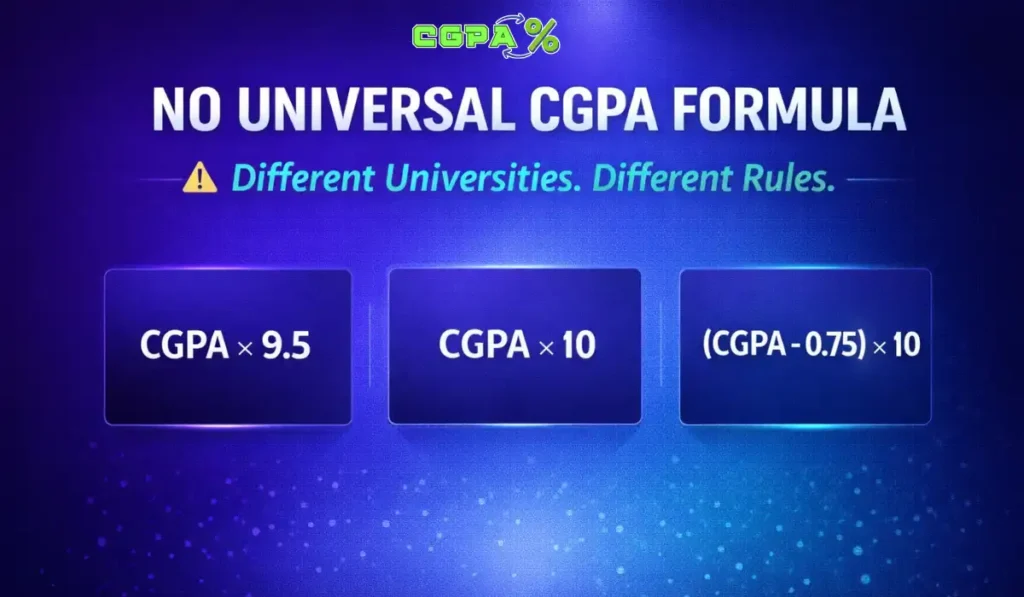
One of the most misunderstood aspects of CGPA conversion is the assumption that one global formula applies everywhere. That assumption is incorrect.
Each university defines its own grading distribution. Some institutions publish official conversion formulas. Others do not. Some provide grade band interpretation tables instead of mathematical multipliers.
For example, certain Indian boards historically used the 9.5 multiplier rule for percentage estimation. Many universities, however, use direct multiplication by 10. Some institutions use adjustment formulas such as subtracting a fixed constant before multiplying.
International universities often do not accept self-calculated conversions at all. They may request transcripts in the original format and conduct an independent evaluation.
You can use our CGPA Calculators to convert your grades accurately as per your university rules. This helps you avoid rounding mistakes and unofficial formulas. You can check your percentage or GPA properly before submitting any application.
Because of these differences, the safest approach is always to:
- Check the official transcript legend page.
- Verify institutional guidelines.
- Avoid assuming that one formula applies everywhere.
CGPA on a 10 Point Scale
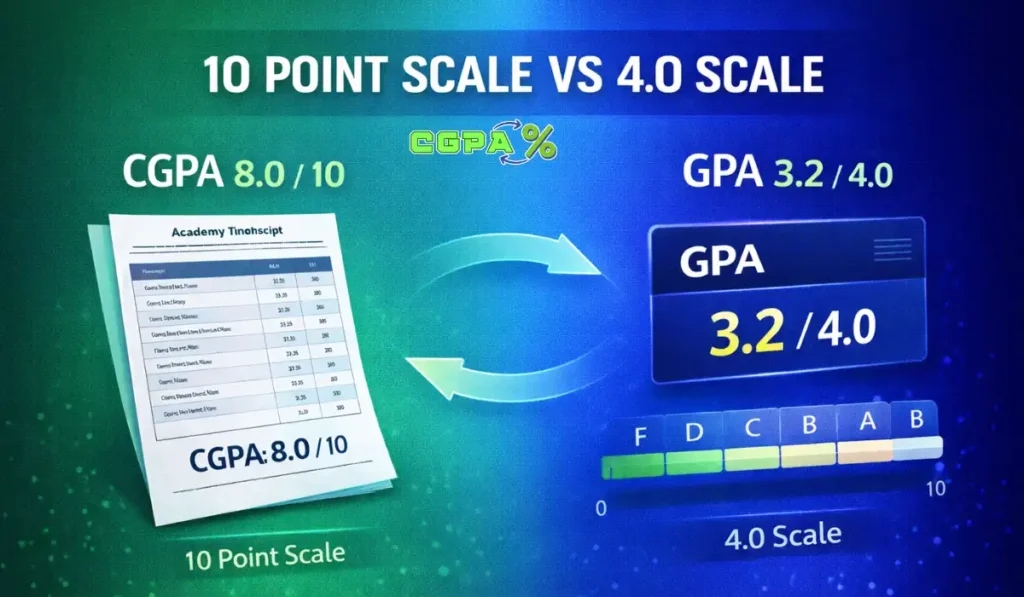
The 10-point scale is common across many universities in India, parts of Europe, and several Asian institutions. Under this structure, grades are assigned values between 0 and 10 based on performance bands.
For internal evaluation, the CGPA is calculated by averaging grade points weighted by course credits. The final CGPA appears on the official transcript.
When applications require percentage conversion, students must consult institutional conversion rules. Some universities explicitly print percentage equivalence formulas on the reverse side of the marksheet.
GPA on a 4.0 Scale
The 4.0 grading system is widely used in the United States and Canada. Letter grades correspond to grade points. For example, an A may equal 4.0, a B may equal 3.0, and so on, depending on institutional policy.
Unlike some 10-point systems, the 4.0 scale often leaves limited room for grade differentiation. Small differences in performance may translate into similar grade point values.
When students from a 10-point system apply to 4.0-based universities, the receiving institution may evaluate transcripts holistically rather than applying a fixed multiplier.
Percentage-Based Systems
In percentage-based systems, grades are expressed directly as numerical percentages. Certain universities classify results as First Class, Distinction, or Honors based on percentage thresholds.
When a percentage is already present on transcripts, conversion to GPA may still be required for international applications. In such cases, credential evaluation agencies or institutional guidelines determine equivalence.
Common Mistakes Students Make During Conversion
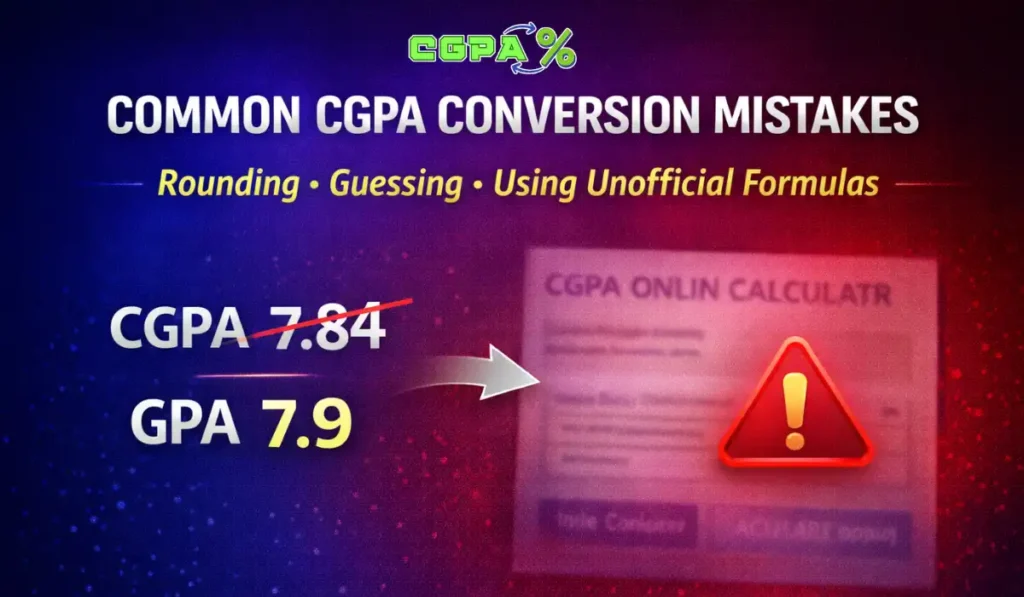
Several errors appear repeatedly in applications.
- Rounding up the CGPA beyond the actual transcript value.
- Applying unofficial online formulas without verification.
- Assuming that multiplying by 10 is always correct.
- Converting into a 4.0 scale without institutional permission.
Misrepresentation, even unintentional, can affect application credibility. Academic integrity policies require accuracy in reporting grades.
When You Should Not Self-Convert
Certain postgraduate programs explicitly instruct applicants not to convert grades. They request original scale values only. In such cases, self-conversion may contradict admission instructions.
Some scholarship boards also state that they will evaluate transcripts internally. If the application does not request converted values, students should provide grades exactly as issued.
When in doubt, follow the receiving institution’s application instructions rather than generalized internet formulas.
Context Matters More Than Raw Numbers

Academic performance does not exist in isolation. Admissions committees often examine grade trends across semesters. Improvement in later years may be viewed positively. Performance in core discipline subjects may carry greater weight than overall CGPA.
A 7.2 CGPA in a rigorous engineering program may be interpreted differently from the same CGPA in a less intensive curriculum. Evaluation frequently considers institutional reputation, grading culture, and subject difficulty.
Converting CGPA to Percentage on a 10 Point Scale
When students apply for government jobs, private sector roles, or postgraduate programs, the percentage format is frequently requested. Many universities using a 10-point scale publish official conversion guidelines. The most reliable source is the transcript legend or academic regulations issued by the university.
One commonly referenced method in certain educational boards is:
Percentage = CGPA × 9.5
This formula was historically applied in specific secondary education boards. However, it does not universally apply to all universities. Many institutions instead use:
Percentage = CGPA × 10
Some technical universities apply modified formulas, such as:
Percentage = (CGPA – 0.75) × 10
Because formulas vary, students must verify the official institutional method before using any multiplier.
Worked Example: Using Different Institutional Rules
Consider a CGPA of 8.2 on a 10-point scale.
If the university applies direct multiplication by 10:
8.2 × 10 = 82%
If the institution applies the 9.5 multiplier:
8.2 × 9.5 = 77.9%
If the university applies the adjustment method:
(8.2 – 0.75) × 10 = 74.5%
The same CGPA produces three different percentage values depending on institutional policy. This example illustrates why students must avoid assuming one universal formula.
Converting 10 Point CGPA to a 4.0 GPA Scale
When applying to universities in the United States or Canada, applicants are often required to report their GPA on a 4.0 scale. Many institutions do not recommend self-calculated conversion. Instead, they evaluate transcripts using internal guidelines or request 3rd party credential evaluation.
A simplistic proportional method sometimes seen online is:
(CGPA ÷ 10) × 4
For example, a CGPA of 8.0 would result in:
(8.0 ÷ 10) × 4 = 3.2
However, this proportional conversion does not account for grade distribution, institutional grading strictness, or subject-level variation. Therefore, it may not reflect the actual evaluated equivalence.
Role of Credential Evaluation Agencies
Credential evaluation agencies analyze academic transcripts and interpret grades within the context of national grading systems. These agencies examine grading scales, credit hours, institutional recognition, and academic rigor.
For example, World Education Services conducts a detailed evaluation and assigns U.S. grade equivalence based on documented grading structures. They do not rely solely on mathematical proportion. Instead, they analyze institutional data and historical performance mapping.
Many postgraduate programs require official evaluation reports before final admission decisions are made. In such cases, students should submit transcripts in original format and allow authorized agencies to determine conversion.
When Universities Perform Internal Conversion
Some universities state clearly in admission instructions that applicants must enter their GPA exactly as printed on transcripts. In these situations, the admissions office performs internal conversion during file review.
Applicants should avoid altering CGPA values unless the application form specifically requires conversion. Providing both the original scale and the converted estimate without authorization may create confusion.
Understanding Grade Bands Instead of Direct Multipliers
Certain institutions classify performance into grade bands rather than strict numeric equivalents. For example:
- First Class: 60% and above
- Distinction: 75% and above
- Second Class: 50 to 59 %
When international institutions evaluate such transcripts, they may convert grade bands rather than raw percentages. Therefore, classification categories often influence equivalence.
Common Errors During International Applications
Several recurring mistakes affect student applications:
- Rounding GPA upward beyond transcript precision.
- Entering an estimated percentage without institutional confirmation.
- Converting to a 4.0 scale when not requested.
- Ignoring instructions regarding credential evaluation requirements.
Accuracy in academic reporting protects application credibility and prevents administrative delays.
Safe Strategy for Students Applying Internationally
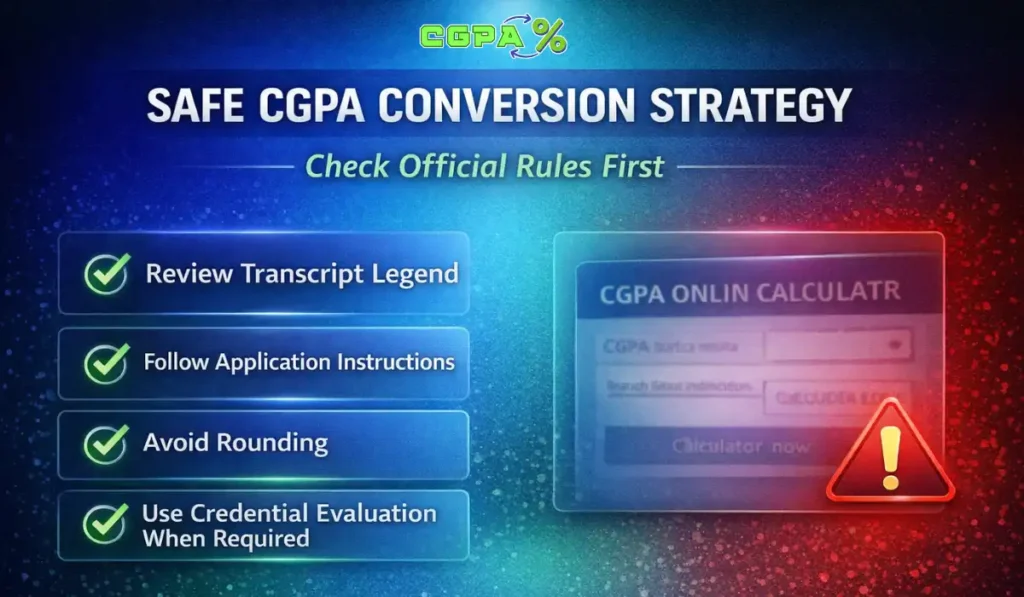
A structured approach reduces conversion errors.
- First, review the transcript legend for the official formula.
- Second, check the application portal instructions carefully.
- Third, provide CGPA in original format unless conversion is explicitly required.
- Fourth, use credential evaluation services when mandated.
- Fifth, avoid rounding beyond two decimal places unless instructed otherwise.
Following institutional guidance is always safer than relying on generalized online formulas.
Common Myths About CGPA Conversion
Misunderstandings about CGPA frequently create unnecessary anxiety among students. Clarifying these misconceptions helps applicants approach conversion and reporting more responsibly.
Myth 1: A larger scale automatically means better performance.
A 9.0 on a 10-point scale is not directly comparable to a 3.6 on a 4.0 scale without institutional context. Performance interpretation depends on grading distribution, academic rigor, and subject difficulty.
Myth 2: Repeated participation guarantees better evaluation.
Conversion does not accumulate advantage across applications. Each institution evaluates transcripts independently within its own framework. Submitting multiple converted estimates does not increase academic standing.
Myth 3: Rounding improves competitiveness.
If a transcript shows 7.84, reporting 7.9 may appear minor, but academic applications require precision. Most institutions recommend reporting grades exactly as issued, typically up to two decimal places.
Myth 4: CGPA alone determines admission outcomes.
Although CGPA functions as a screening benchmark, admissions decisions frequently incorporate additional academic indicators such as research projects, entrance test scores, letters of recommendation, and academic statements.
Learn how to write better answers
Sometimes students know the answer, but still lose marks because of poor presentation. Writing style matters more than you think.
- Structure your answers clearly.
- Start with a brief introduction, explain the main points, and conclude properly if needed.
- Use simple language and avoid unnecessary complexity.
- Highlight key terms where appropriate.
- If your essay topic is challenging, avail yourself of essay writing services, as they can guide you in structuring responses effectively.
Once you learn how to present answers well, your marks naturally improve even with the same level of knowledge.
How Admissions Committees Interpret Academic Trends
Postgraduate admissions committees rarely examine only the final CGPA number. Instead, they review semester-wise performance to understand academic trajectory.
An upward trend from early low performance to stronger final year grades may indicate academic growth and maturity. Conversely, declining performance in advanced courses may prompt further review.
Departments also analyze subject-specific performance. For example, engineering programs may focus closely on mathematics and core technical subjects. Business programs may evaluate quantitative and analytical coursework separately from elective subjects.
Consistency, improvement, and subject strength often carry interpretive weight beyond the raw average.
Institutional Reputation and Grading Culture
Admissions committees consider institutional context. Some universities follow strict grading policies where high CGPA scores are rare. Others may exhibit grade concentration in upper bands.
Credential evaluation agencies and experienced admissions reviewers often recognize such grading cultures. Therefore, two identical CGPA values from different institutions may not be interpreted identically.
Understanding this context helps students avoid unnecessary comparison across unrelated systems.
Long-Term Role of CGPA Beyond Graduation
CGPA does not disappear after degree completion. Academic transcripts remain part of formal documentation required for postgraduate study, research funding, government examinations, and certain professional licensing processes.
Doctoral programs frequently request complete academic transcripts from both undergraduate and master’s studies. Research grants may require academic performance verification. In some regulated professions, academic standing forms part of eligibility documentation.
While work experience may gradually reduce emphasis on GPA in industry roles, academic institutions continue to record and reference transcript performance.
Practical Guidelines Before Submitting Applications
Before submitting academic or professional applications, students should:
- Review transcript for accuracy.
- Verify official conversion rules if required.
- Report grades exactly as printed.
- Attach transcript legend when permitted.
- Avoid using unofficial rounding methods.
- Follow the application portal instructions precisely.
Accurate documentation strengthens credibility and reduces administrative clarification requests.
Final Takeaways on CGPA Conversion
CGPA conversion is not a universal mathematical shortcut. It is an institutional process shaped by grading structures, evaluation policies, and contextual interpretation.
Students should prioritize official guidance over online assumptions. When institutions request original scale reporting, applicants should comply without modification. When credential evaluation is required, authorized agencies should perform conversion.
Understanding the structure behind grading systems allows applicants to present their academic records clearly and responsibly. Proper reporting ensures that the evaluation focuses on academic merit rather than preventable documentation errors.
Frequently Asked Questions
Is multiplying CGPA by 9.5 always correct?
No. The 9.5 multiplier was historically applied in specific educational boards. Universities follow their own official formulas. Students must confirm institutional guidelines before applying any multiplier.
Can I convert my 10-point CGPA directly into a 4.0 GPA myself?
Some institutions allow proportional estimation, but many universities conduct internal conversion or require credential evaluation agencies. Applicants should follow the official admission instructions.
Does a lower CGPA permanently limit postgraduate opportunities?
Not necessarily. Admissions committees examine academic trends, subject performance, and additional qualifications. Improvement over time may positively influence evaluation.
Should I round my CGPA for simplicity?
Academic reporting requires precision. Most institutions expect grades to match official transcripts exactly, typically up to two decimal places.
When is credential evaluation mandatory?
Credential evaluation is usually required when applying internationally and is specified in admission instructions. Universities clearly indicate when third-party assessment reports are necessary.